Rank Math vs Yoast SEO: Which Is Better for WordPress in 2026?
Choosing an SEO plugin is one of the first decisions many WordPress website owners make.Two names appear repeatedly in that conversation:
Rank Math and Yoast SEO.Both plugins can handle important WordPress SEO tasks, including search appearance settings, XML sitemaps, structured data, content analysis, and other technical SEO functions.But they take somewhat different approaches.Rank Math is known for packing a large number of features into its plugin, including advanced schema controls, redirects, 404 monitoring, SEO analysis, and integrations. Its current feature set also includes tools such as Search Console integration, rank tracking, and Content AI, although the availability of particular features can depend on the free or Pro version.
Yoast takes a more structured approach around content optimization, readability, technical SEO, schema, and its broader ecosystem. Its current settings include SEO analysis, readability analysis, XML sitemaps, Schema Framework, and internal-linking features, with some capabilities reserved for Premium.
So which one should you install?
For most beginners, the better plugin is not the one with the longest feature list. It is the one you can configure correctly and actually use.
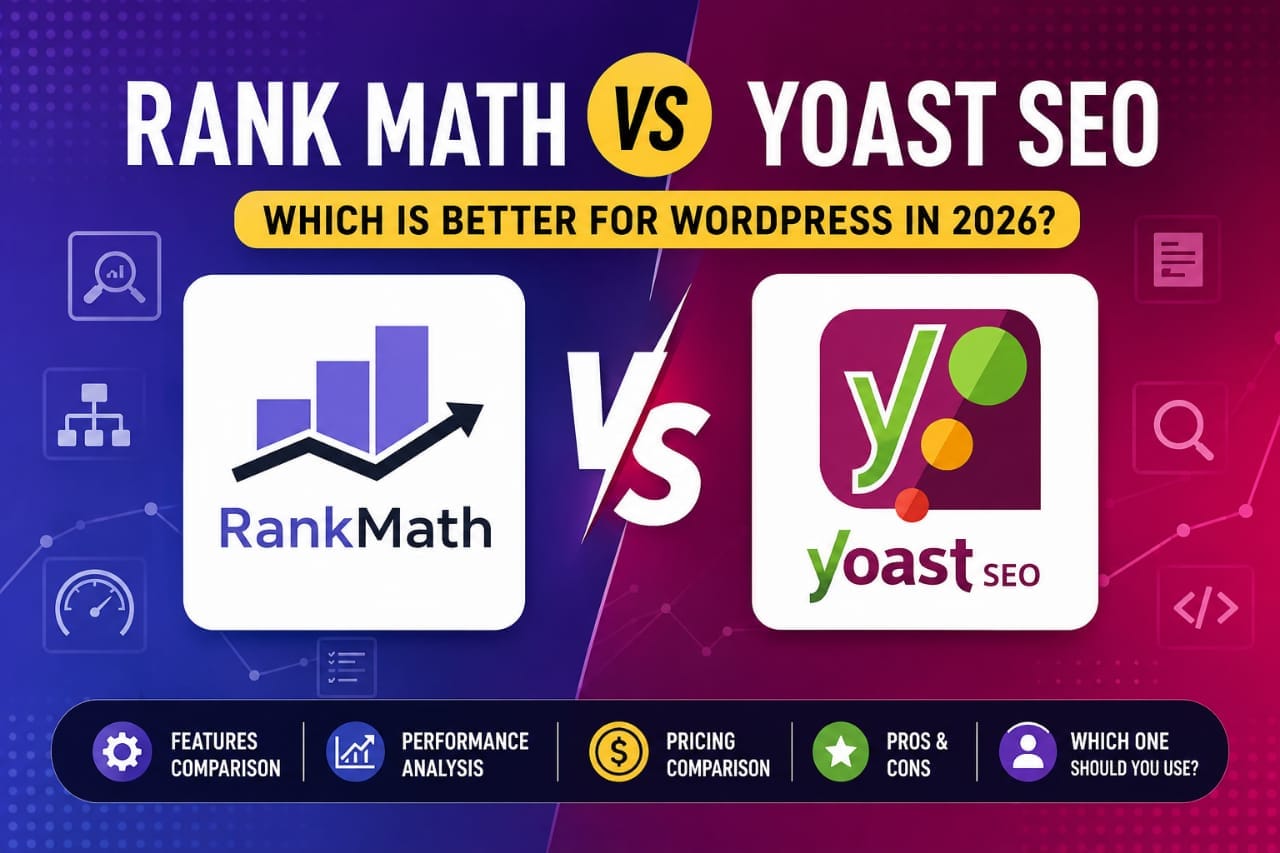
Rank Math vs Yoast SEO at a Glance
Before looking at individual features, here is the practical difference.Rank Math generally appeals to users who want many SEO controls available inside WordPress.Yoast is particularly attractive to users who prefer a mature, structured SEO workflow with strong content analysis and a well-developed documentation and learning ecosystem.
Neither plugin can guarantee higher Google rankings.An SEO plugin helps you implement and manage SEO settings. It does not replace keyword research, useful content, internal linking, technical maintenance, backlinks, or search-intent analysis.
Rank Math: What Makes It Different?
Rank Math has built its reputation around offering a large feature set from a single WordPress plugin.Its current feature list includes SEO analysis, schema tools, redirects, 404 monitoring, Search Console integration, content optimization, social previews, and other SEO controls.
One of its strongest advantages is modularity.
You can enable the modules you actually need instead of necessarily using every feature.This matters because a beginner may only need basic SEO settings, while a more advanced site owner may want redirects, schema customization, analytics, rank tracking, or other tools.
Rank Math's Main Strength: Feature Density
If you like having many SEO functions available from one dashboard, Rank Math is appealing.For example, Rank Math provides a built-in 404 monitor and redirection functionality, while its schema system allows users to create and manage different structured-data configurations.
This can reduce the need to install separate plugins for some SEO tasks.However, more features can also mean more settings to understand.That is not automatically an advantage for every beginner.
Yoast SEO: What Makes It Different?
Yoast SEO has been part of the WordPress SEO ecosystem for many years.Its approach is centered heavily around making SEO concepts understandable while giving users structured controls for content and technical optimization.
The current Yoast SEO settings include SEO analysis, readability analysis, XML sitemaps, Schema Framework, Open Graph data, and other site-level features.
Yoast also automatically builds a connected Schema graph for the website, helping describe the relationships between different pieces of structured data.

Yoast's Main Strength: Structured Content Optimization
Yoast is particularly useful if you want guidance while writing.Its SEO analysis and readability analysis can provide suggestions around content structure and optimization.
This does not mean you should follow every green indicator blindly.An article can have a perfect plugin score and still fail to satisfy search intent.Use the recommendations as guidance rather than treating the score as a ranking formula.
Rank Math vs Yoast SEO: Feature Comparison
Which Plugin Has Better Schema Features?
Both plugins support structured data, but their approaches are different.Rank Math provides a custom Schema Builder and supports multiple Schema types from its interface. Yoast uses a connected Schema Framework that creates a structured data graph rather than treating every piece of markup as an isolated block.
For a beginner who simply needs appropriate Article, WebPage, Organization, or breadcrumb structured data, either plugin can be sufficient.The important thing is to avoid adding unnecessary or contradictory schema.Structured data should accurately represent visible page content.It should not be treated as a shortcut for obtaining rich results.
Which Is Better for Content Optimization?
This is where personal preference becomes important.Yoast has a long-established content analysis and readability workflow. Its current SEO sidebar provides keyphrase analysis, search appearance controls, social settings, schema controls, and other content-related features.
Rank Math also provides content analysis and SEO scoring, alongside additional tools within the same interface.
If you prefer a relatively guided writing workflow, Yoast may feel more intuitive.If you prefer having more controls available inside the WordPress editor, Rank Math may be more appealing.Neither plugin's score should become your primary writing objective.A useful article should satisfy the reader before it satisfies a plugin checklist.
Rank Math vs Yoast for Beginners
For a beginner, simplicity matters.Rank Math can be attractive because many functions are accessible from one plugin.That can be convenient, especially if you want features such as redirects, 404 monitoring, schema controls, and other SEO functions without assembling several separate plugins. Rank Math documents these capabilities as part of its feature set.
However, beginners can also become overwhelmed by the number of available settings.Yoast can be a better fit if you prefer a more structured learning experience and want the plugin to guide you through core SEO concepts.The best choice depends on how you like to work.
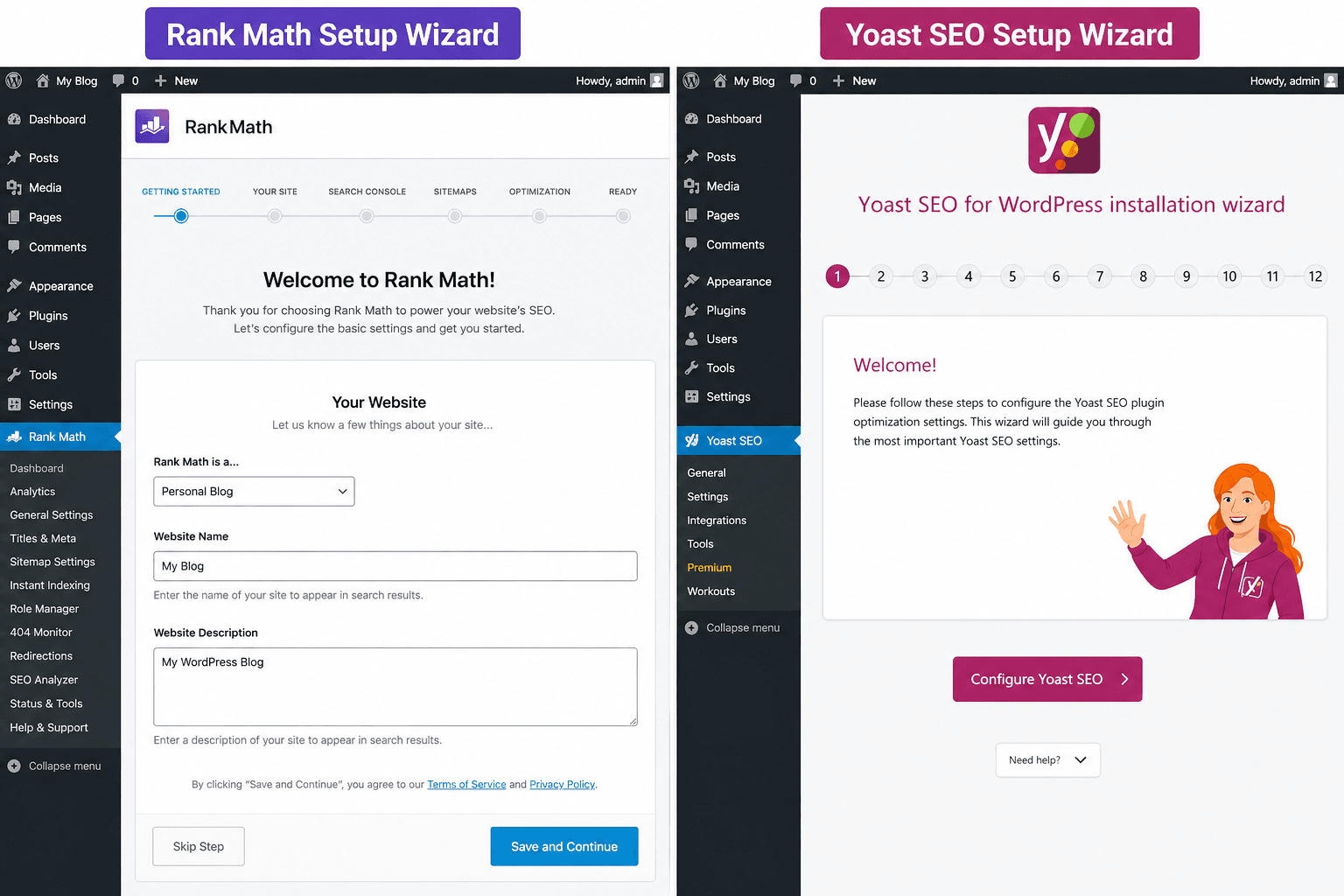
Which Is Better for Technical SEO?
Both plugins can handle important technical SEO tasks.You can manage search appearance settings, XML sitemaps, canonical information, robots directives, structured data, and other technical elements.Rank Math has an advantage if you want additional built-in tools such as its 404 monitor and redirection manager.
Yoast provides extensive technical controls as well, including its Schema Framework, XML sitemaps, breadcrumbs, archive controls, and advanced indexing settings. For most small WordPress blogs, you do not need every advanced feature.The key is configuring the fundamentals correctly.
What About AI Features?
Both plugins have moved further into AI-assisted SEO.Rank Math offers Content AI as part of its ecosystem. 16Yoast currently offers AI features including AI-generated titles and descriptions, AI Optimize, and an AI Summarize block, with these capabilities primarily associated with Premium.
But an AI feature should not be considered a ranking advantage by itself.AI can help you brainstorm, optimize, organize, or improve content.It cannot guarantee that an article satisfies search intent.Do not choose an SEO plugin simply because it has more AI buttons.
Choose the plugin whose overall workflow fits your website.
Should You Switch SEO Plugins?
Does Rank Math Improve Rankings More Than Yoast?
There is no reliable reason to assume that installing Rank Math instead of Yoast will automatically produce better rankings.Both plugins help you implement SEO controls.Your rankings depend on much more than your
SEO plugin.Content quality, relevance, search intent, site structure, internal linking, backlinks, technical accessibility, competition, and user satisfaction all play roles.A perfectly configured SEO plugin cannot compensate for an article that does not answer the searcher's question.Your SEO plugin is infrastructure. Your content is the actual value delivered to the visitor.
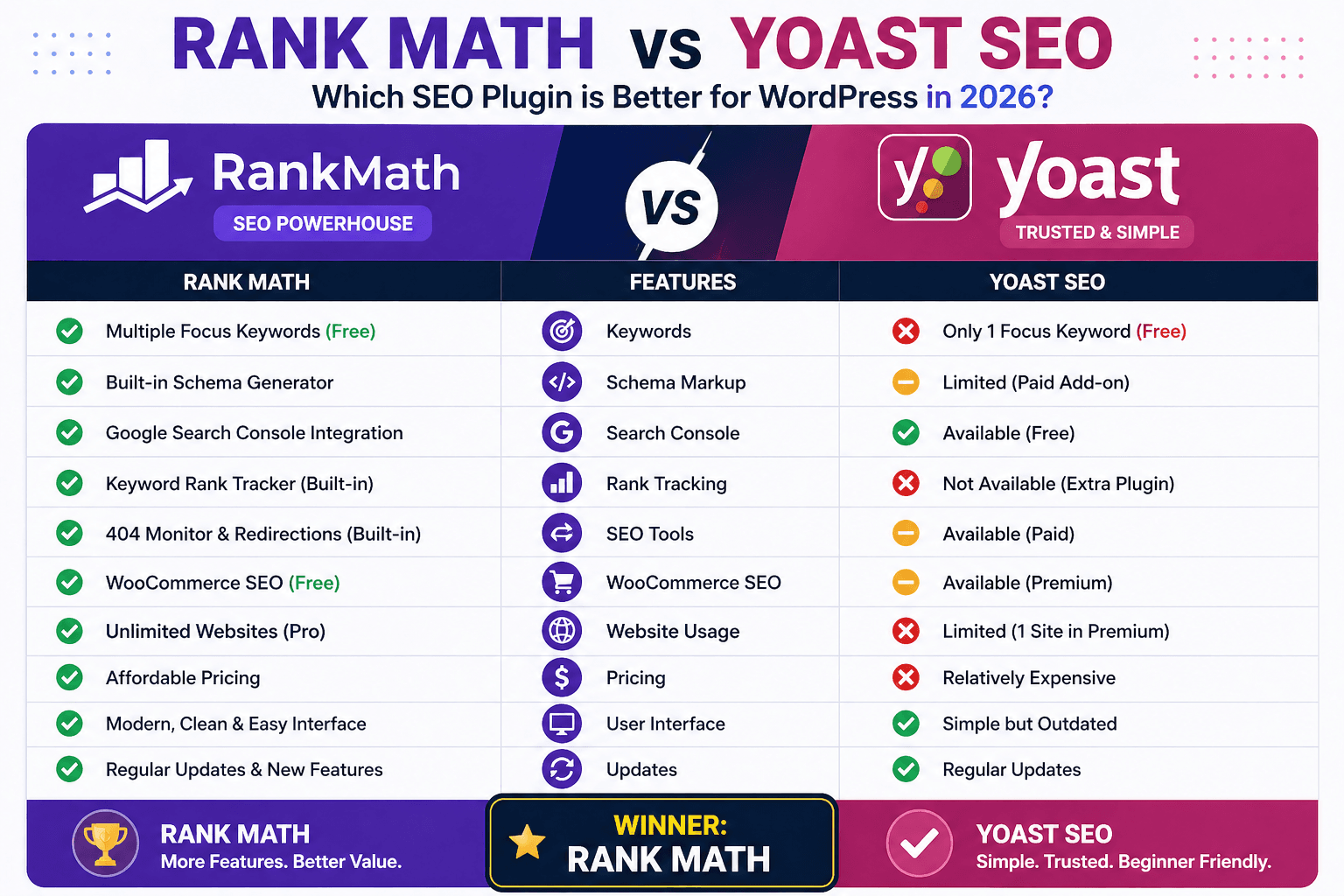
Rank Math vs Yoast: Which One Should You Choose?
Choose Rank Math if you:
- Want a large number of SEO features in one plugin
- Want built-in tools such as 404 monitoring and redirects
- Want extensive schema controls
- Prefer a feature-rich dashboard
- Want more SEO functions available without installing multiple plugins
Choose Yoast if you:
- Prefer structured content guidance
- Value readability analysis
- Like a mature SEO workflow
- Want its connected Schema Framework
- Prefer Yoast's broader learning and documentation ecosystem
There is no need to switch simply because one plugin is popular.If your current SEO plugin is working correctly and you understand its settings, continuing with it can be the better decision.
Final Verdict
So, Rank Math vs Yoast SEO—which is better?
For users who prioritize a broad set of built-in SEO controls, Rank Math is a very strong option.For users who prefer a structured content-optimization workflow and Yoast's established ecosystem, Yoast SEO remains a strong choice.For a beginner building a small WordPress blog, I would not make the decision based solely on feature count.
Choose the interface you understand.Configure the fundamentals correctly.Keep your sitemap and indexing settings under control.Use appropriate structured data.Write useful content.Build logical internal links.Monitor Search Console.And avoid changing SEO plugins repeatedly in the hope of triggering a ranking boost.
The best SEO plugin is ultimately the one that helps you manage SEO correctly without getting in the way of creating a better website.
Both Rank Math and Yoast can provide that foundation.The final decision should therefore come down to your preferred workflow, required features, budget, and how much control you actually need.
One thing the comparison only touches on lightly: Rank Math’s modular system is a genuine advantage on shared hosting because you can disable every module you don’t need. Yoast loads its full feature stack on every page even if you only use the meta tags. For a lean WordPress setup, we run something similar with all unnecessary modules turned off.
Thanks for sharing your insights, Tomás. Rank Math’s modular setup is definitely useful for improving performance on lightweight WordPress sites. Disabling unnecessary features can make a noticeable difference in speed and resource usage, especially on shared hosting.