How to Write Evergreen Blog Posts That Rank for Years
Most blog posts have a short life.
You publish an article, it gets some traffic, rankings change, competitors publish newer content, and eventually the article becomes almost invisible in Google.Evergreen content follows a different strategy.An evergreen blog post answers a problem that people continue to search for months or years after publication. But evergreen does not mean “write it once and forget it.”
A strong evergreen article combines a durable topic with useful information, good structure, original insights, internal links, and periodic updates.If you want organic traffic that can continue working long after publication, evergreen content should be part of your SEO strategy.
What Is Evergreen Content?
Evergreen content is content that remains useful for a long period because the underlying reader problem does not disappear quickly.
Examples include:
- How to start a blog
- How to improve website speed
- How to create a WordPress website
- How to write an SEO-friendly article
- How to build an email list
- Common WordPress mistakes
- How to perform keyword research
Compare these with topics such as “Google algorithm update today” or “Best AI tools this month.”The second group can generate traffic, but their usefulness can decline quickly.Evergreen content targets a long-lasting problem rather than a temporary event.
Evergreen Does Not Mean Never Updating
This is one of the biggest misconceptions.An article can be evergreen while still requiring updates.For example, “How to Create a WordPress Website” is an evergreen topic. People will continue creating websites.But WordPress interfaces, hosting options, plugins, security recommendations, and SEO practices can change.
Therefore, the topic remains evergreen while parts of the article need maintenance.Google's guidance also warns against changing dates simply to make an unchanged page appear fresh. Updates should represent meaningful improvements rather than cosmetic changes.
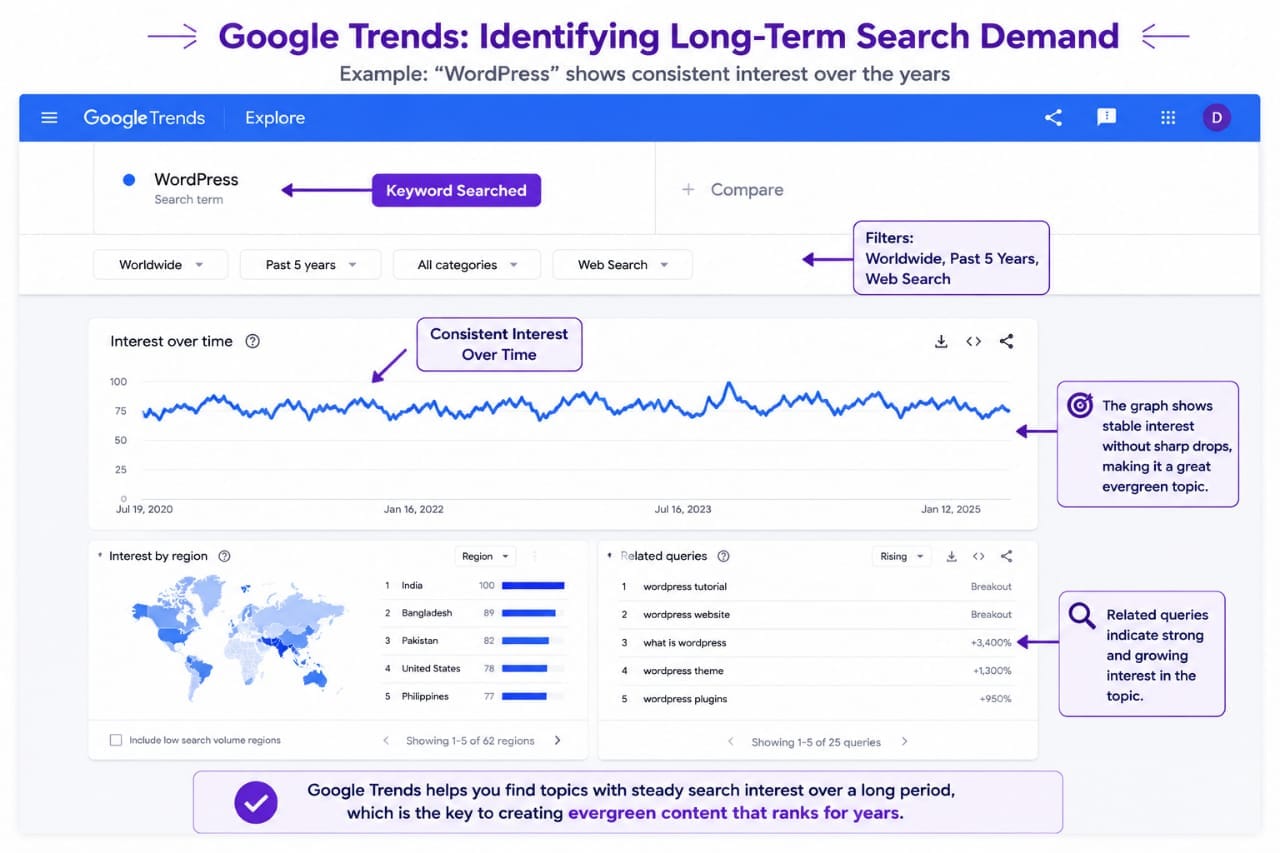
Choose the Right Evergreen Topic
The topic determines how durable your article can become.Before writing, ask:
“Will people still have this problem two or three years from now?”
If the answer is yes, you may have an evergreen opportunity.
Look for problems that are:
- Frequently searched
- Connected to a recurring need
- Not dependent on one temporary event
- Broad enough to remain relevant
- Specific enough to solve clearly
Don't choose a topic simply because a keyword has search volume.A keyword can have traffic today and still be a poor long-term investment if the underlying subject changes rapidly.
Focus on the Problem Behind the Keyword
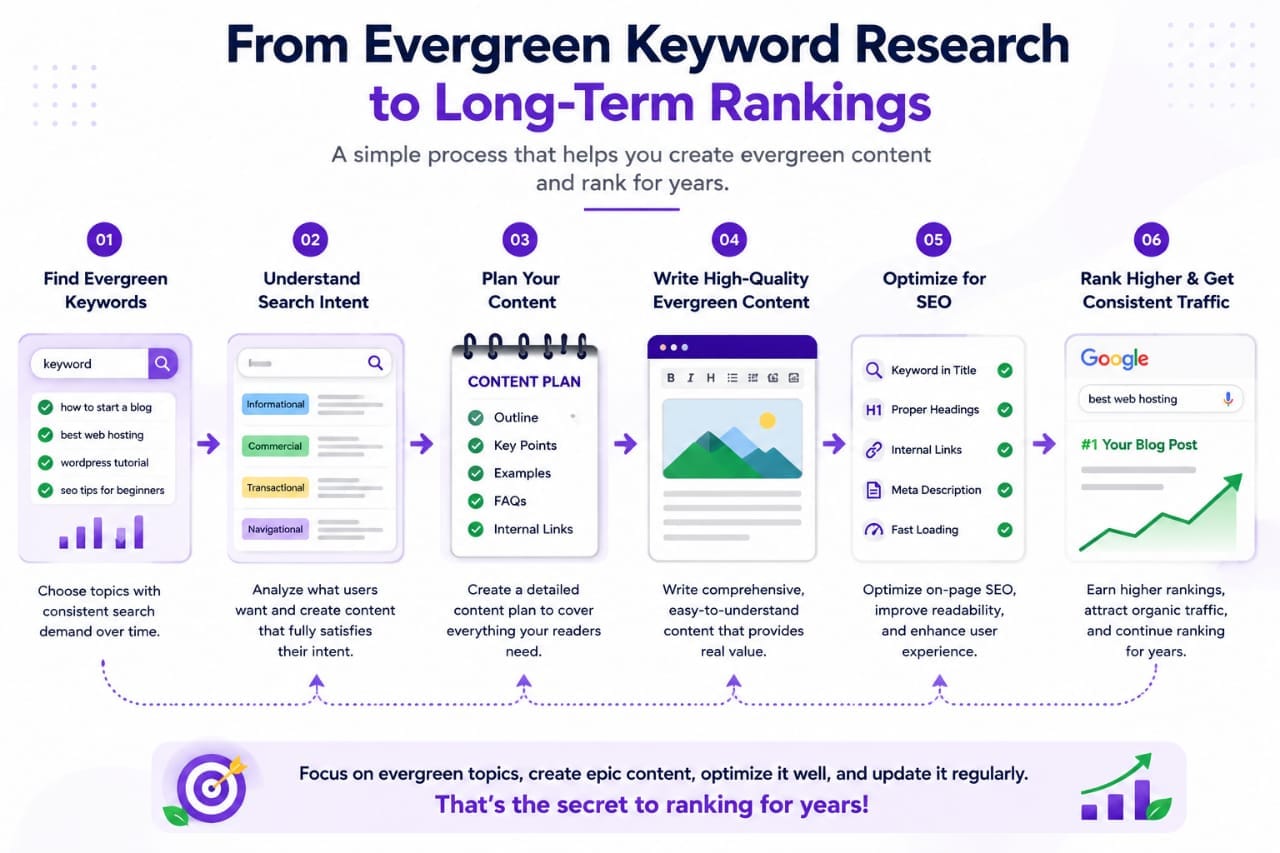
One of the strongest ways to create durable content is to understand why someone searches for the topic.Suppose the keyword is:
“WordPress website slow”
The reader probably doesn't just want a definition.They may want to know:
Why is my website slow?
Which plugin is causing it?
How can I test the problem?
What should I fix first?
What should I avoid?
A strong evergreen article answers the complete problem behind the search.This makes the content more useful than an article written only around keyword repetition.
Build a Complete Content Structure
Evergreen content should be easy to scan and easy to revisit.Use a logical structure such as:IntroductionDirect answerWhy the problem happens
Step-by-step solution
Examples
Common mistakes
Comparison or decision section
FAQs
Conclusion
Use descriptive H2 and H3 headings so readers can quickly locate the information they need.Don't add sections simply to make the article longer.Google explicitly says there is no preferred word count.
The goal is to provide a substantial, complete answer rather than reaching an arbitrary number of words.
Add Original Information
This is where many “evergreen” articles fail.Search results are already full of articles explaining the same basic concepts.If your article simply rewrites what ten competitors have already said, there is little reason for someone to prefer your version.
Add something original:
- Your own testing
- Screenshots
- Real examples
- Performance results
- Mistakes you've encountered
- Step-by-step observations
- Original comparisons
- Practical recommendations
Google's current guidance specifically encourages original information, research, analysis, and substantial additional value rather than simply rewriting other sources.
Create Content That Can Survive Changes
Avoid making every sentence dependent on information that can quickly become outdated.For example, instead of writing:
“Plugin X is the fastest WordPress plugin in 2026.”
Use a more durable approach:“Caching plugins can improve delivery performance when configured correctly, but results depend on the hosting environment, website configuration, and page resources.”The second statement is less dependent on a specific year or temporary ranking.
This doesn't mean avoiding dates completely.If a date genuinely matters, include it.The goal is to separate timeless principles from temporary details.
Evergreen Content vs Trending Content
Build Internal Links Around Evergreen Content
An evergreen article shouldn't exist alone.Connect it with related articles on your website.For example, a WordPress speed guide could link to:
- How to find a slow WordPress plugin
- How to reduce image size
- How to improve Core Web Vitals
- Hosting comparisons
- WordPress caching guides
Internal links help readers discover related information and help search engines understand relationships between pages. Google's ranking systems include link analysis among the systems used to understand pages and their relationships.
Your strongest evergreen articles can also become hubs that distribute relevance to related pages.
Update Evergreen Posts Strategically
Don't wait until an article completely loses traffic.Review important evergreen pages periodically.Check:
- Are statistics outdated?
- Are screenshots still accurate?
- Are links working?
- Have recommended tools changed?
- Are there better examples?
- Has the search intent changed?
- Are competitors providing something your article lacks?
- Can you answer the question more clearly?
Don't change the publication date just because the article is old.Make meaningful improvements first.Google specifically warns against changing dates when the content has not substantially changed.
Optimize Evergreen Content for Modern Search
Evergreen content should also work for today's search environment.Use:
- Clear answers
- Descriptive headings
- Useful examples
- Original information
- Relevant internal links
- Accurate facts
- Good page experience
- Helpful images
- Concise FAQs
Google's guidance for AI search also continues to emphasize unique, valuable, non-commodity content and good page experience. Traditional SEO remains foundational.
This means you don't need to create completely different “AI content.”Create genuinely useful content first.
Avoid These Evergreen Content Mistakes
The most common mistakes are:Writing generic content.Choosing keywords without understanding search intent.Adding unnecessary words to reach a target word count.Copying competitor structures without adding original value.Never updating important information.
Using outdated screenshots.Changing dates without meaningful updates.Publishing dozens of similar articles instead of improving existing ones.Google explicitly says creators shouldn't write to an arbitrary word count and shouldn't primarily produce content to attract search-engine traffic.
How to Make an Evergreen Post Rank for Years
There is no formula that guarantees a page will rank for years.Search results change. Competitors improve. Search intent evolves. Google's ranking systems also change.
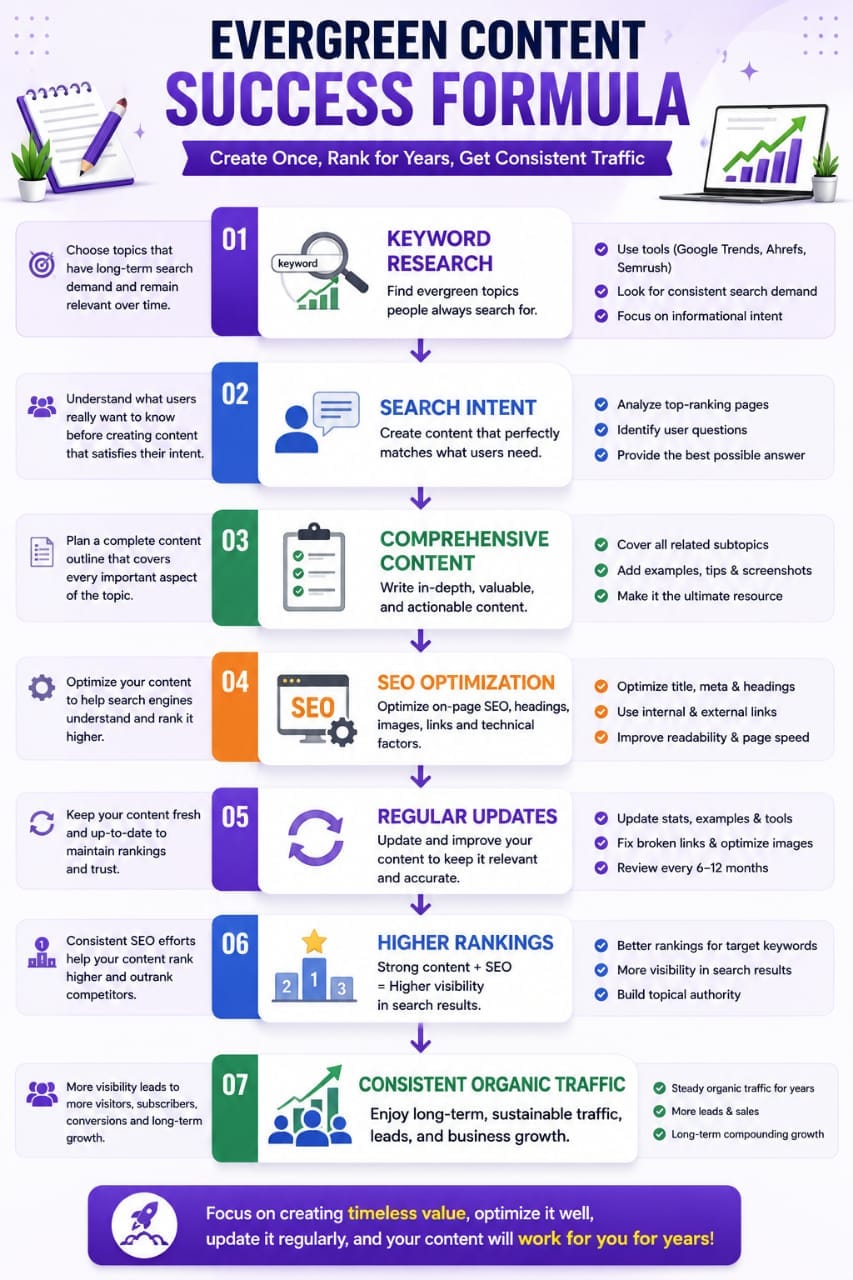
But you can build stronger long-term potential by following this process:
Choose a durable problem.
Research the actual search intent.
Create a complete and useful outline.
Add original experience and analysis.
Write for people first.Optimize the technical basics.
Build internal links.
Publish the article.
Monitor performance in Search Console.
Update it when information or search intent changes.Improve the article instead of automatically creating another one.
Final Verdict
Evergreen content is not content that you publish once and forget.It is content built around a durable problem and maintained as the web changes.The strongest evergreen articles answer the reader's real question, provide information competitors don't have, use clear structure, and continue improving over time.
Don't chase the idea of a “perfect evergreen article.”Create something useful today, make it better tomorrow, and keep improving it whenever the information or reader's needs change.
That is a much more realistic strategy for building blog posts capable of generating organic traffic for years.