AI Content vs Human Content: Which Is Better for SEO in 2026?
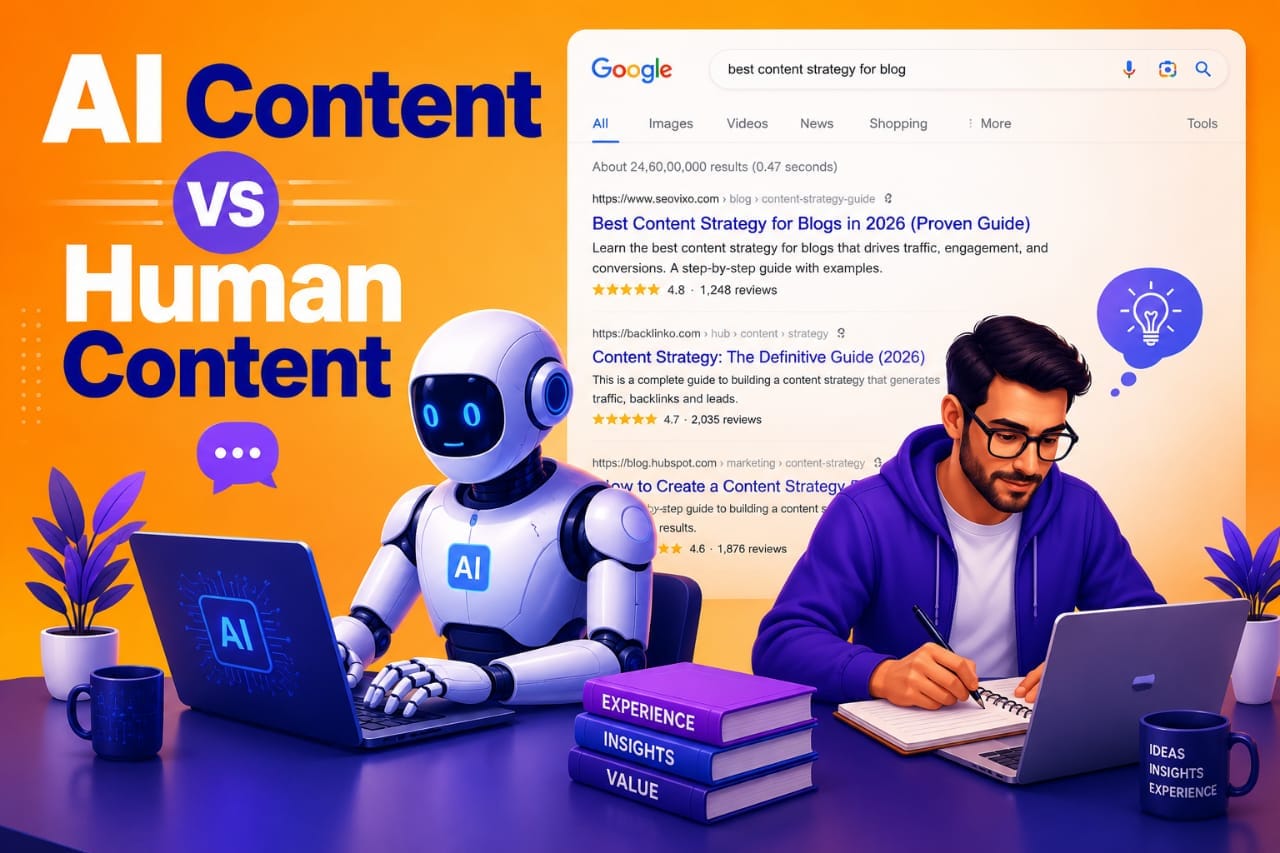
AI has changed the way bloggers create content.An article outline that once took an hour can now be produced in minutes. Research can be organized faster, repetitive writing tasks can be reduced, and content creators can generate ideas whenever they get stuck.
But this has created a bigger question for bloggers:Does AI-generated content perform as well as content written by humans?
The answer is more complicated than simply choosing AI or humans.Google does not say that content should rank or fail based solely on whether artificial intelligence was used. Its current guidance focuses on whether content is helpful, reliable, original, created for people, and capable of providing genuine value.
The real SEO question is not “Was AI used?” It is “Did the final content become genuinely useful?”
That changes how bloggers should approach AI.Instead of treating AI as an automatic article generator, it is better to use it as a productivity tool while keeping human judgment, research, editing, and originality at the center.
What Is AI-Generated Content?
AI-generated content is text produced partly or substantially with the help of artificial intelligence.Modern AI systems can help create:
- Article outlines
- Drafts
- Topic ideas
- Meta descriptions
- Product descriptions
- Social media posts
- Content summaries
- Editing suggestions
- Content structures
The biggest advantage is speed.AI can produce a starting point much faster than writing everything from a blank document.But speed is not the same as quality.
A generated draft may still contain outdated information, weak explanations, repetitive sections, incorrect assumptions, or generic advice.That means the first draft should not automatically become the final article.
What Is Human-Written Content?
Human-written content is created primarily through a person's own knowledge, research, experience, judgment, and writing ability.The biggest advantage is not simply that a human physically typed the words.It is the ability to contribute information that may not exist in the source material being summarized.
A blogger can explain what happened when they actually used a hosting provider.A developer can describe how a technical problem was solved.A business owner can explain what worked and what failed.A writer can provide an original opinion supported by reasoning and evidence.
Human contribution becomes especially valuable when the topic benefits from experience, testing, judgment, or original analysis.
What Does Google Say About AI Content?
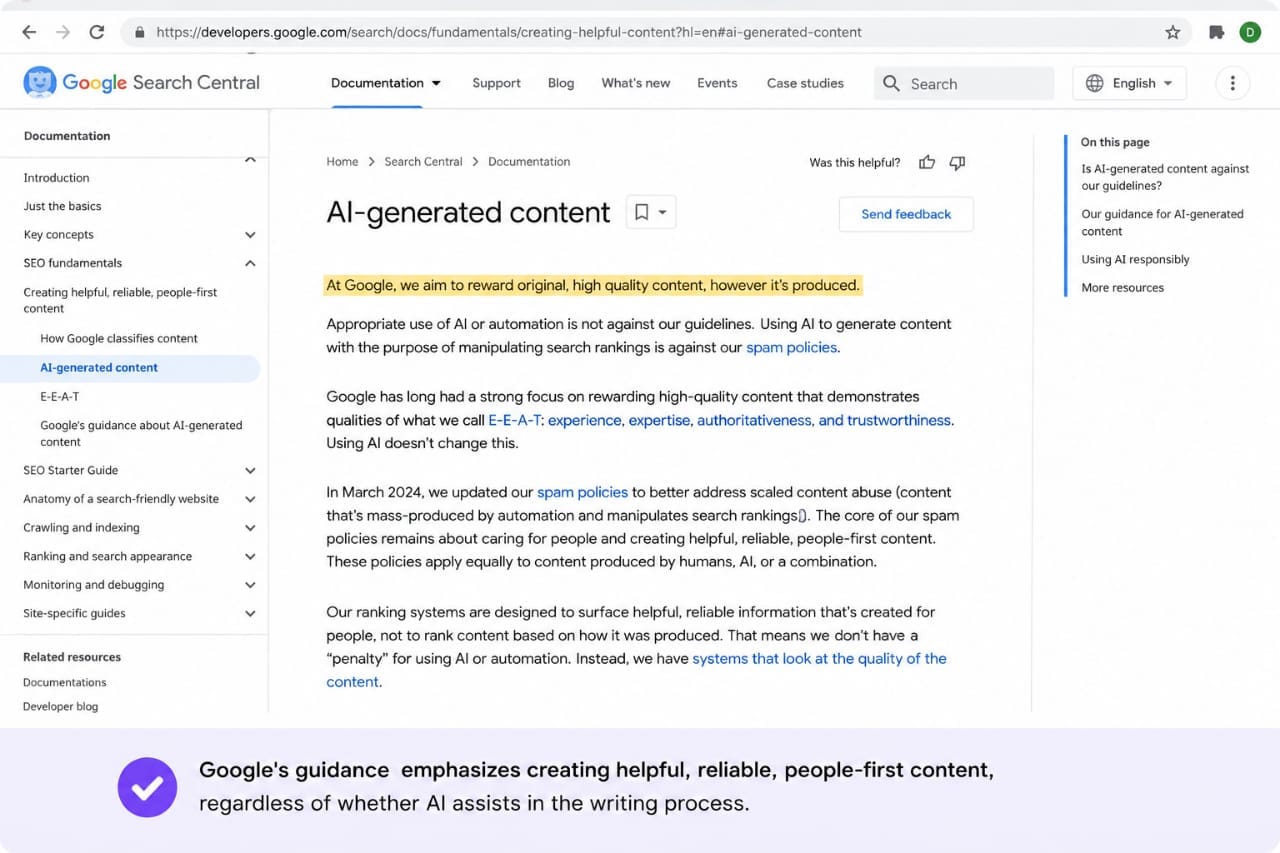
This is where many articles get the topic wrong.Google's guidance does not say that every AI-generated article is automatically bad.Instead, Google emphasizes people-first content and warns against creating large amounts of content primarily to manipulate search rankings. Its spam policies specifically identify scaled content abuse, including AI-generated pages that provide little or no additional value to users.
This means the method of production is not the only issue.Imagine two articles.The first is completely human-written but contains inaccurate information, repeats what every competitor already says, and provides no useful insight.The second uses AI during research and drafting but is heavily edited, fact-checked, supported by original examples, and provides genuinely useful information.The second article may be more valuable to readers.That is why the AI-versus-human argument is too simplistic.
AI Content vs Human Content: Key Differences
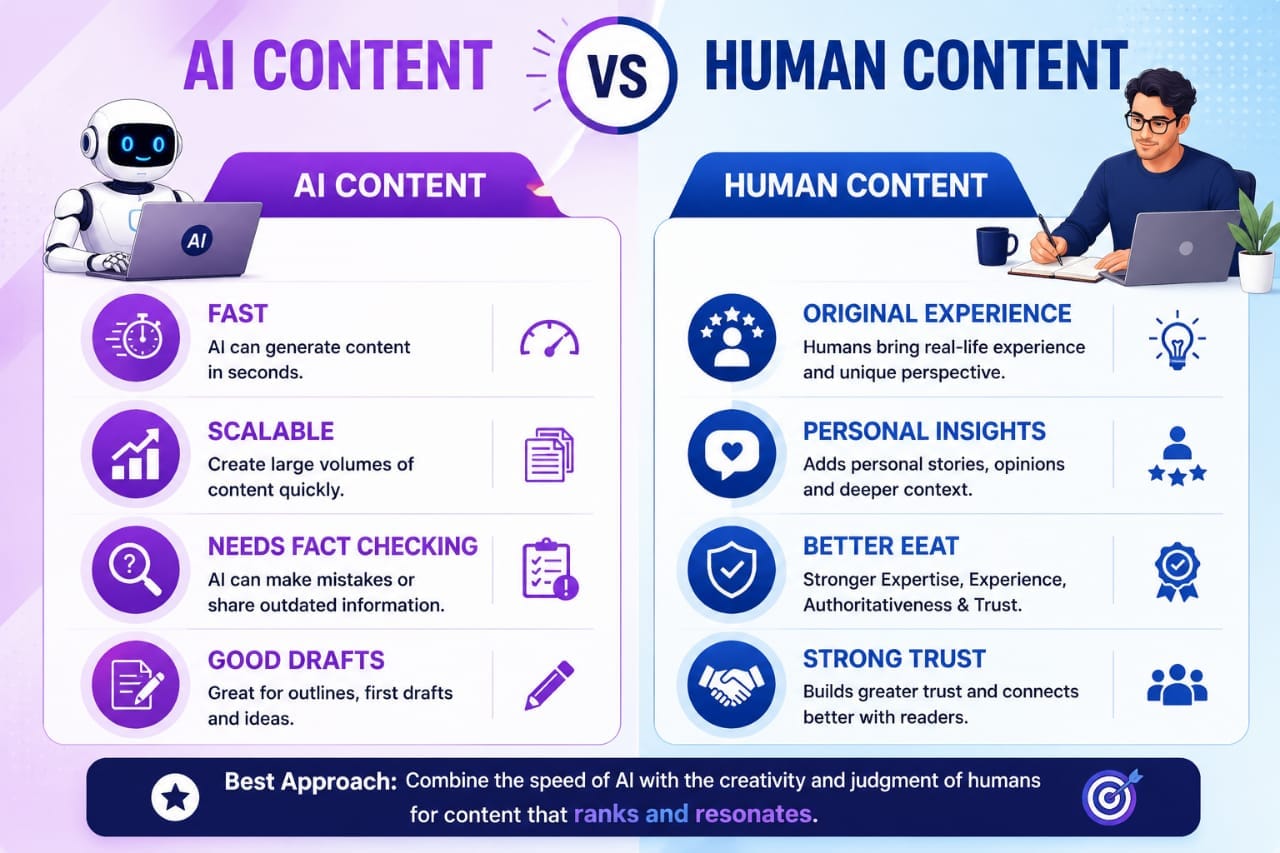
The biggest differences are related to speed, originality, experience, research assistance, and scalability.
Where AI Content Has a Major Advantage
AI is extremely useful for reducing repetitive work.For example, you can use it to turn a rough collection of ideas into an organized outline.It can help identify subtopics you may have forgotten.It can also suggest alternative titles, rewrite awkward sentences, summarize research notes, or help you organize a large amount of information.
This makes AI particularly useful during the preparation stage.Instead of staring at a blank page, you have something to work from.But that draft should be treated as raw material.The creator still needs to decide what belongs in the final article.
Where Human Content Has the Biggest Advantage
Human expertise becomes particularly important when the reader needs information that cannot be obtained simply by summarizing existing sources.Consider a hosting review.An AI system can explain what SSD hosting means.But someone who actually used a hosting provider can explain:
What the dashboard felt like to use.
How migration worked.
Whether support was helpful.
What problems occurred.
What changed after upgrading.
Those details create a more useful article because they add information beyond generic definitions.
Google's current people-first guidance specifically encourages original information, analysis, first-hand expertise, and content that provides substantial value beyond what is already available elsewhere.
Original experience is one of the strongest ways to make content less generic.
Does Human-Written Content Automatically Rank Better?
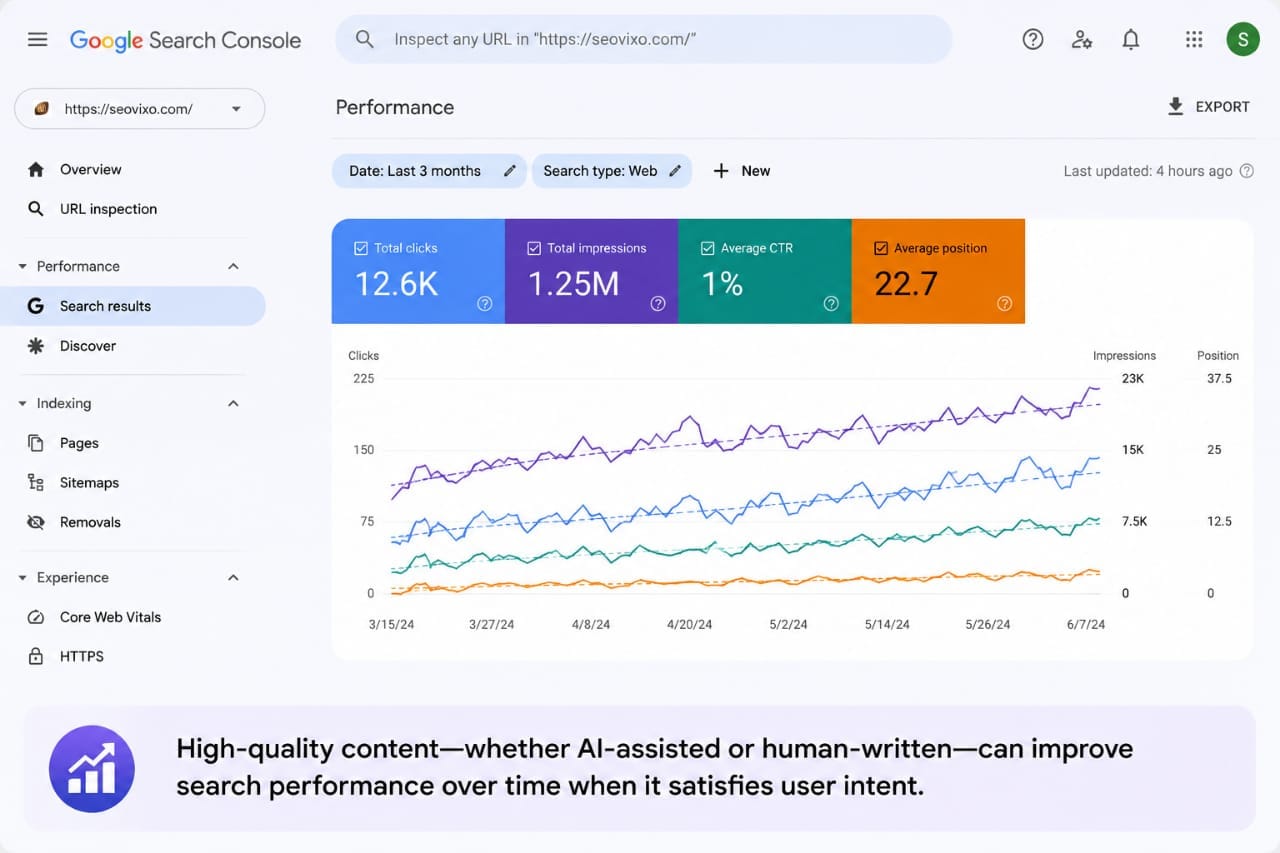
No.This is another common misconception.Being written entirely by a human does not automatically make an article valuable.
A human can produce a thin article.
A human can copy competitors.
A human can publish outdated information.
A human can write an article that completely misses search intent.
The important question is what the reader receives.If an AI-assisted article provides accurate information, useful examples, strong organization, original analysis, and a satisfying answer, its production method alone does not make it worthless.
Likewise, human writing is not automatically superior simply because a person wrote it.
Why Editing Matters So Much With AI
One of the biggest problems with AI content is the temptation to publish the first output.That is where quality can decline.AI-generated drafts may contain:
- Repetitive explanations
- Generic introductions
- Unsupported claims
- Outdated information
- Missing context
- Overly confident statements
- Similar wording across different articles
A human editor should therefore check the article from the reader's perspective.
Is every important claim accurate?
Does the article actually answer the question?
Are examples specific?
Is anything repeated?
Does the article add information that competitors do not?
Would you personally recommend this article to someone?If the answer is no, more editing is need
AI Content and E-E-A-T
Experience, Expertise, Authoritativeness, and Trustworthiness are important concepts when evaluating content quality.AI can help organize information, but it cannot genuinely claim that it personally tested a product, ran a website, interviewed a customer, or experienced a particular problem.
That distinction matters.If you did something yourself, explain what happened.If you tested a tool, show the process.
If you analyzed your own Search Console data, explain what you discovered.If you have professional knowledge, use it to provide context.These are the elements that make an article more difficult to replace with a generic AI summary.
The Best Strategy: AI-Assisted, Human-Led Content
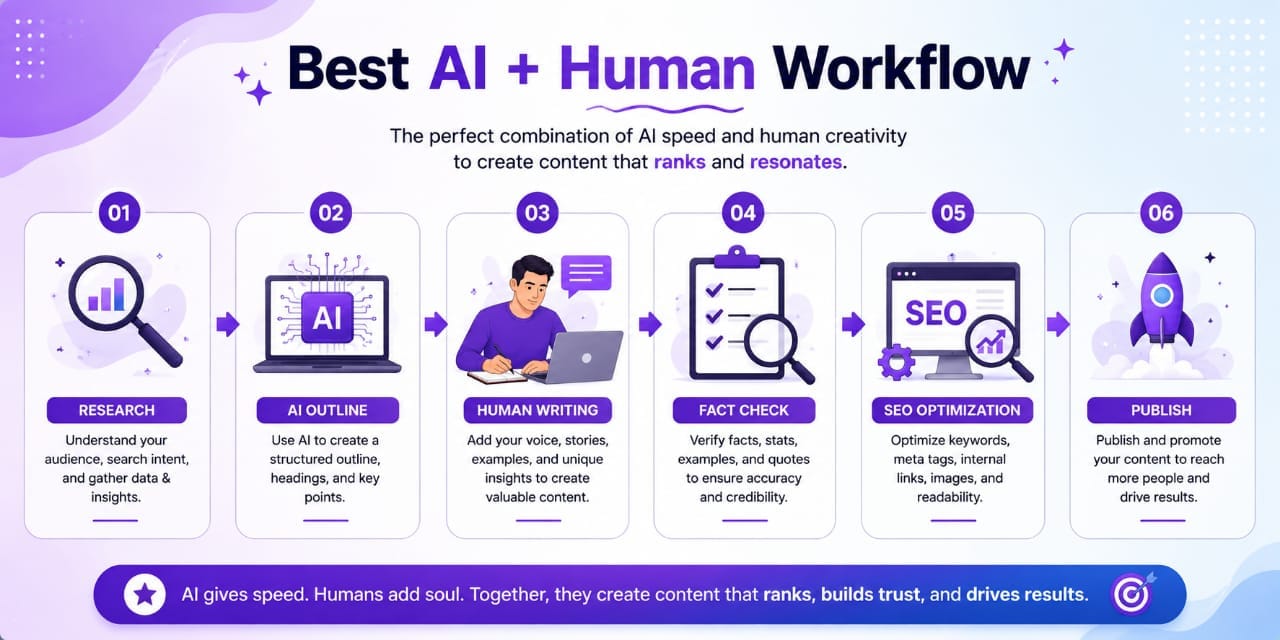
For most bloggers, the strongest approach is not choosing one side.Use AI where it saves time.Use human judgment where it adds value.A practical workflow can look like this:Research the topic.Understand the search intent.Create an initial outline.
Use AI to brainstorm missing angles.Write or develop the important sections.
Add original examples and experience.Verify factual claims.Remove generic or repetitive sections.Improve the introduction and conclusion.Add useful internal links.
Optimize the page for search without forcing keywords.Then read the final article as if you were the visitor.This workflow allows AI to improve productivity without turning your website into a collection of mass-produced pages.
Google's current guidance specifically says AI can be useful for research and adding structure to original content, while warning against using it to generate many pages without adding value.
When Should You Use AI?
AI is particularly useful for:
- Brainstorming ideas
- Creating outlines
- Organizing research
- Finding possible subtopics
- Improving grammar
- Rewriting unclear sentences
- Generating title variations
- Creating meta descriptions
- Summarizing your own notes
- Creating content checklists
These uses can save time without removing the creator from the process.
When Should You Use AI?
AI is particularly useful for:
- Brainstorming ideas
- Creating outlines
- Organizing research
- Finding possible subtopics
- Improving grammar
- Rewriting unclear sentences
- Generating title variations
- Creating meta descriptions
- Summarizing your own notes
- Creating content checklists
These uses can save time without removing the creator from the process.
When Should You Rely More Heavily on Human Writing?
Use more human-led writing when the article depends on:
- Personal experience
- Product testing
- Case studies
- Original research
- Expert opinions
- Technical troubleshooting
- First-hand experiments
- Personal recommendations
- Industry-specific judgment
The more an article depends on experience and judgment, the more important human contribution becomes.
Can AI Replace Human Writers?
AI can replace some repetitive writing tasks.
It can reduce the amount of time required to create drafts
.It can also help a single blogger produce content more efficiently.
But replacing the entire human role is a different question.Someone still needs to decide what deserves to be published, verify important information, add original insight, understand the audience, evaluate competitors, and take responsibility for the final result.
AI can accelerate content production. It does not remove the need for editorial responsibility.
Common AI Content Mistakes
The biggest mistake is publishing AI output without meaningful review.The second is creating dozens of articles simply because AI makes production easy.The third is producing content on unrelated topics with no connection to your audience.
Google's current guidance specifically warns against extensive automation used to produce search-engine-first content and against scaled production of pages that provide little added value.
Another mistake is trying to hide the fact that AI was used while making unsupported claims about personal experience.If an article says you personally tested something, that experience should actually exist.Accuracy matters more than appearances.
Final Verdict
AI content is not automatically bad.Human content is not automatically good.The difference is what happens during the creation process.AI is excellent at speed, organization, brainstorming, and repetitive tasks.Humans are essential for judgment, originality, experience, fact-checking, context, and responsibility.For a blogger in 2026, the smartest approach is therefore not:
“AI or human?
”It is:“How can I use AI to work faster while making the final article more useful than a generic AI answer?”
That means using AI as an assistant rather than an automatic publishing machine.Research with it.Plan with it.Organize with it.Edit with it.But add your own knowledge, evidence, examples, experience, and judgment.
The future of SEO content is not about proving that a human typed every sentence. It is about proving that the final content is worth reading.
If your article gives visitors information they cannot easily get elsewhere, answers their real question, demonstrates appropriate expertise, and leaves them satisfied, you are building the kind of content that can remain valuable as Google Search continues to evolve.