Free Keyword Density Checker Tool (2026) – Analyze SEO Keywords Like a Pro
Keyword density remains one of the most discussed topics in search engine optimization. While modern search engines are far more advanced than they were a decade ago, understanding how frequently your target keywords appear in content can still help improve on-page SEO and content relevance.

If you're a blogger, content marketer, SEO professional, or website owner, a keyword density checker can help you identify keyword overuse, improve readability, and create content that better matches search intent.
In this guide, you'll learn what keyword density is, why it matters, how to calculate it, common mistakes to avoid, and how to use the Seovixo Free Keyword Density Checker Tool effectively.
Keyword density is not a direct Google ranking factor. However, monitoring keyword usage can help prevent keyword stuffing and improve content optimization.
📑 Table of Contents
- What Is Keyword Density?
- Keyword Density Formula
- Why Keyword Density Matters for SEO
- Does Google Use Keyword Density as a Ranking Factor?
- What Is Keyword Stuffing?
- Benefits of Using a Keyword Density Checker
- Best Practices for Keyword Usage
- How a Keyword Density Checker Works
- Keyword Density vs Keyword Frequency
- How SEO Professionals Use Keyword Density Analysis
- Common Keyword Density Mistakes
- How to Analyze Competitor Content
- Keyword Density and Semantic SEO
- Recommended Keyword Density Guidelines
- Why Bloggers Need a Keyword Density Checker
- Keyword Density Myths You Should Ignore
- Real Example: Optimizing a Blog Post
- Keyword Density vs Modern SEO Factors
- SEO Best Practices Beyond Keyword Density
- Helpful SEO Resources
- Why Use the Seovixo Free Keyword Density Checker?
- Final Thoughts
- Frequently Asked Questions
- Key Takeaway
What Is Keyword Density?
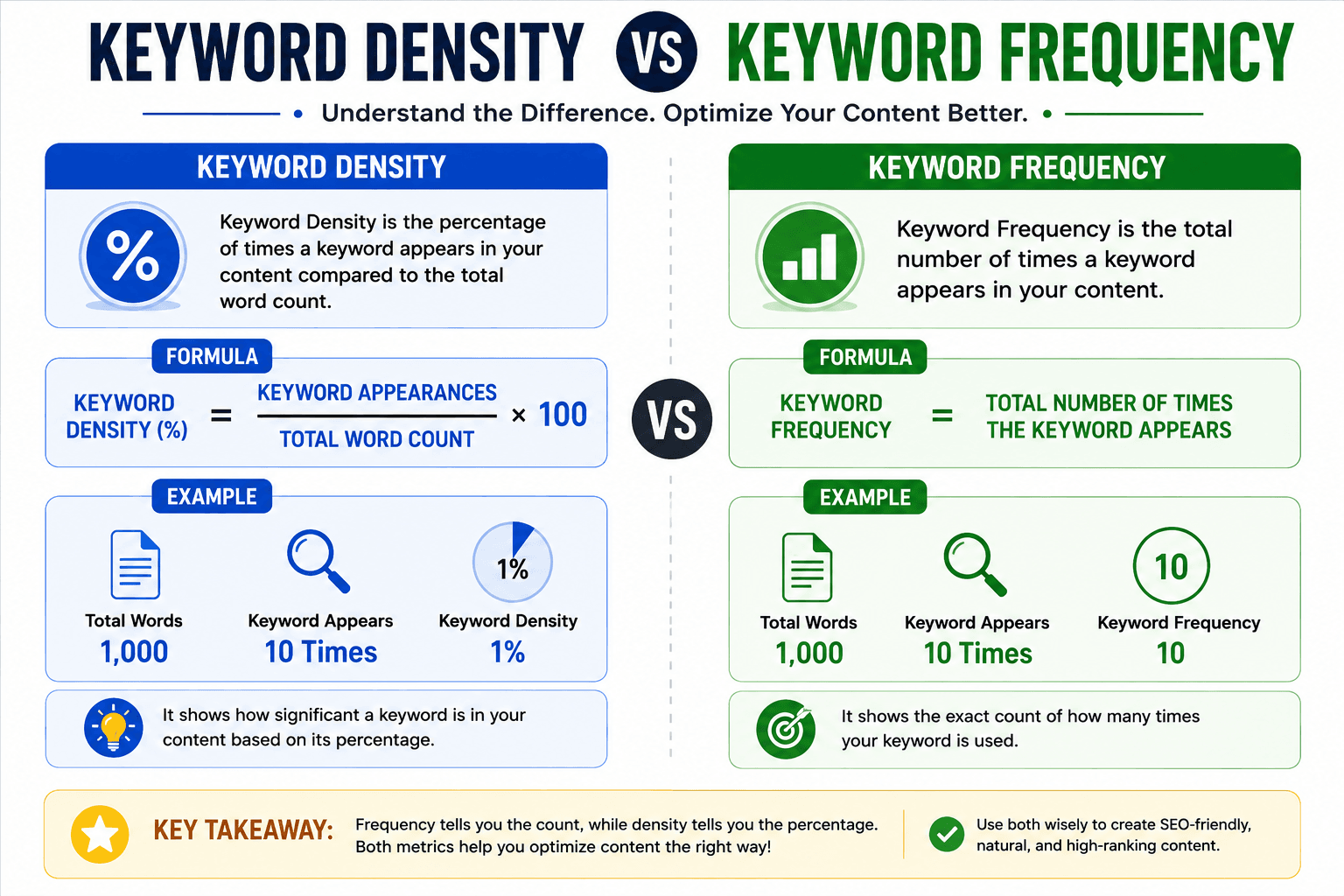
Keyword density refers to the percentage of times a keyword appears on a page compared to the total number of words.
For example, if your article contains 1,000 words and your target keyword appears 10 times, the keyword density would be 1%.
SEO professionals use keyword density analysis to understand how often important phrases appear within content.
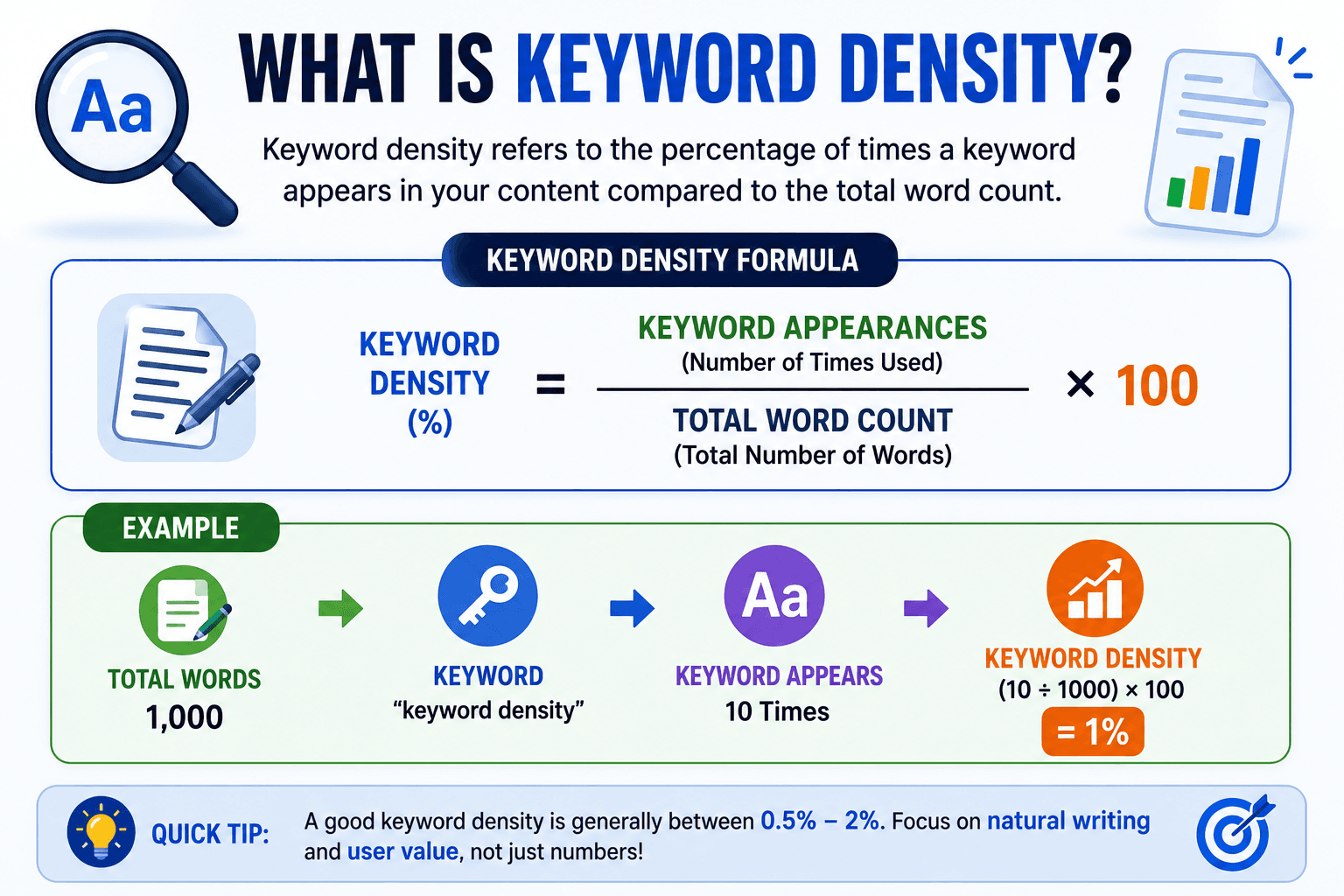
A keyword density checker automates this process and helps identify:
- Primary keywords
- Secondary keywords
- Keyword frequency
- Over-optimization issues
- Content relevance
Keyword Density Formula
The formula is simple:
Example:
- Total Words = 2,000
- Keyword Uses = 20
Keyword Density:
(20 ÷ 2000) × 100 = 1%
A keyword density checker performs this calculation instantly.
Why Keyword Density Matters for SEO
Modern search engines rely heavily on semantic understanding, user intent, and content quality.
However, keyword usage still provides contextual signals.
Proper keyword placement helps search engines understand:
- The page topic
- Main subject relevance
- Search intent alignment
- Content structure
Keyword density analysis is particularly useful when optimizing:
- Blog posts
- Landing pages
- Affiliate content
- Product descriptions
- Service pages
Does Google Use Keyword Density as a Ranking Factor?
The short answer is no.
Google has repeatedly emphasized that there is no ideal keyword density percentage.
Instead, Google focuses on content quality, helpfulness, and relevance.
You can learn more about Google's content systems from:
Google Search Central Documentation
That said, keyword density tools remain useful because they help detect unnatural keyword repetition.
What Is Keyword Stuffing?
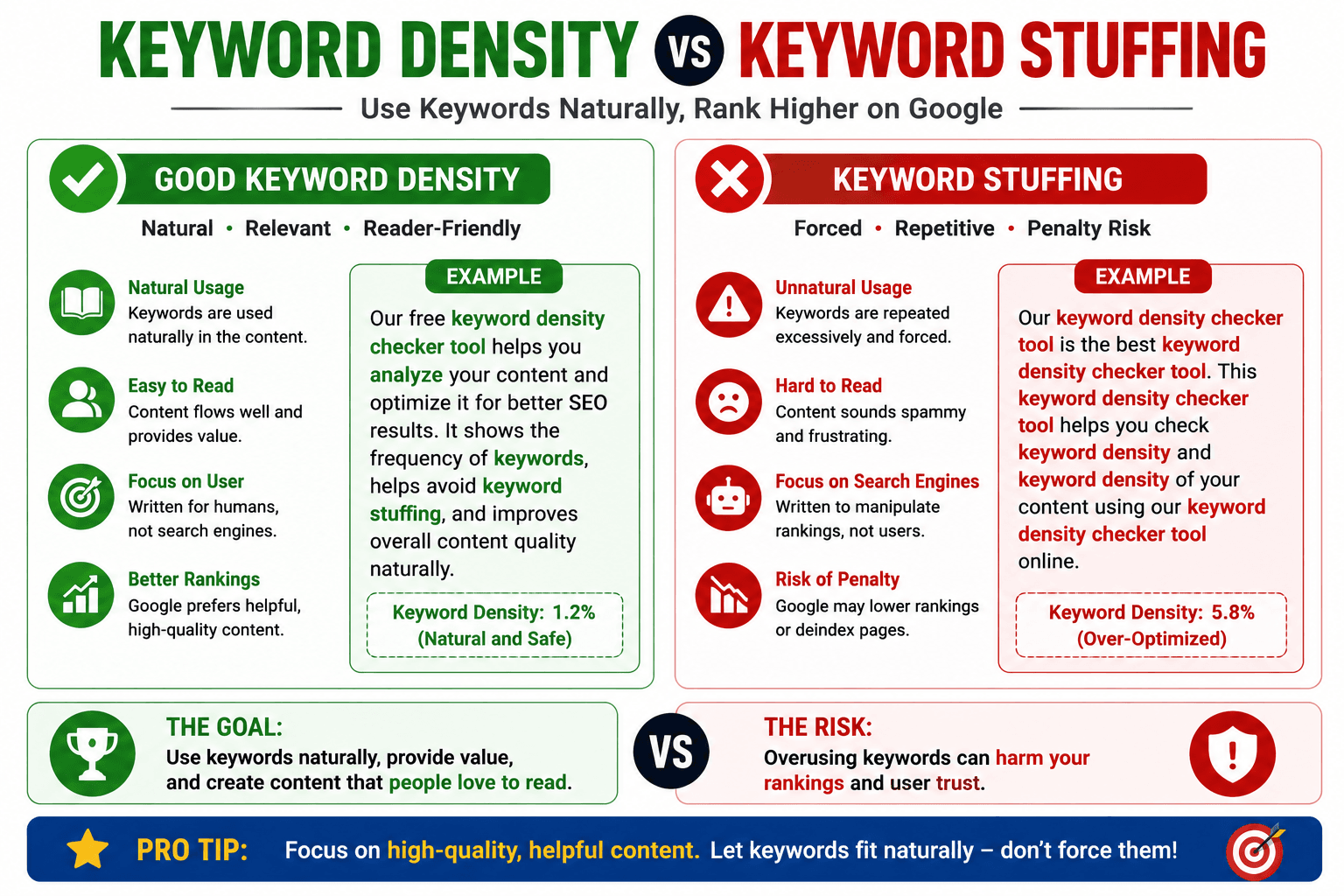
Keyword stuffing occurs when a keyword is repeated excessively in an attempt to manipulate rankings.
Example:
"Best keyword density checker is the best keyword density checker because the keyword density checker helps you check keyword density."
This creates a poor user experience and can reduce content quality.
Writing for search engines instead of humans often leads to keyword stuffing and lower content quality.
Benefits of Using a Keyword Density Checker
- Detect keyword stuffing
- Improve content balance
- Identify keyword opportunities
- Optimize on-page SEO
- Improve readability
- Analyze competitor content
- Enhance topical relevance
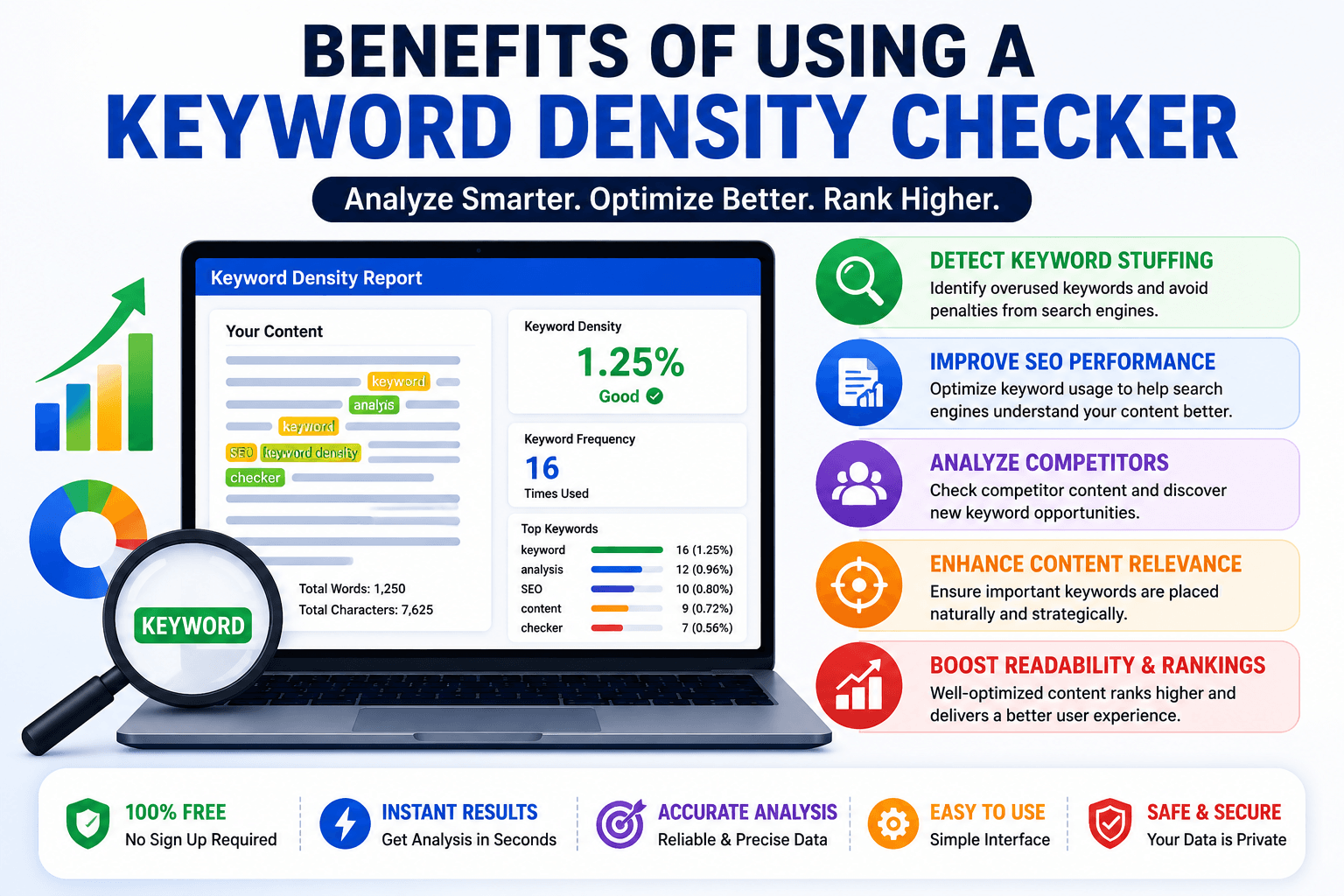
Professional content creators often use keyword density analysis as part of a broader SEO workflow.
Best Practices for Keyword Usage
- Use keywords naturally
- Focus on user intent
- Add related terms and synonyms
- Write comprehensive content
- Avoid forced repetition
- Optimize headings and subheadings
Instead of chasing a specific percentage, focus on creating content that fully answers the user's question.
How a Keyword Density Checker Works
A keyword density checker scans your content and calculates how frequently specific words or phrases appear.
Instead of manually counting keywords, the tool automatically analyzes:
- Total word count
- Keyword frequency
- Keyword density percentage
- Single-word keywords
- Two-word phrases
- Three-word phrases
- Most frequently used terms
The Seovixo Keyword Density Checker instantly processes your content and provides an easy-to-understand report.
Don't analyze only your own content. Run competitor articles through a keyword density checker to understand how top-ranking pages cover a topic.
Keyword Density vs Keyword Frequency
Many beginners confuse keyword density with keyword frequency.
| Metric | Meaning |
|---|---|
| Keyword Frequency | Number of times a keyword appears |
| Keyword Density | Percentage of keyword occurrences compared to total words |
Example:
- Article Length = 1,500 Words
- Keyword Uses = 15
Frequency = 15
Density = 1%
Both metrics help evaluate content optimization.
How SEO Professionals Use Keyword Density Analysis
Experienced SEO professionals rarely use keyword density as a standalone ranking metric.
Instead, they combine it with:
- Search intent analysis
- Competitor research
- Content depth
- Topical authority
- Internal linking
- Content structure
A keyword density report helps ensure important terms appear naturally throughout the page.
Common Keyword Density Mistakes
Many website owners misuse keyword density tools.
Here are some of the most common mistakes.
1. Chasing an Exact Percentage
There is no universal "perfect" keyword density.
Every topic and article is different.
Trying to force a keyword to reach a specific percentage often creates unnatural content.
2. Ignoring Search Intent
Keyword density cannot replace user-focused writing.
Content should solve problems and answer questions.
3. Overusing Exact Match Keywords
Modern search engines understand synonyms and related phrases.
You don't need to repeat the exact keyword excessively.
4. Forgetting Secondary Keywords
Many successful pages rank because they cover related terms and subtopics.
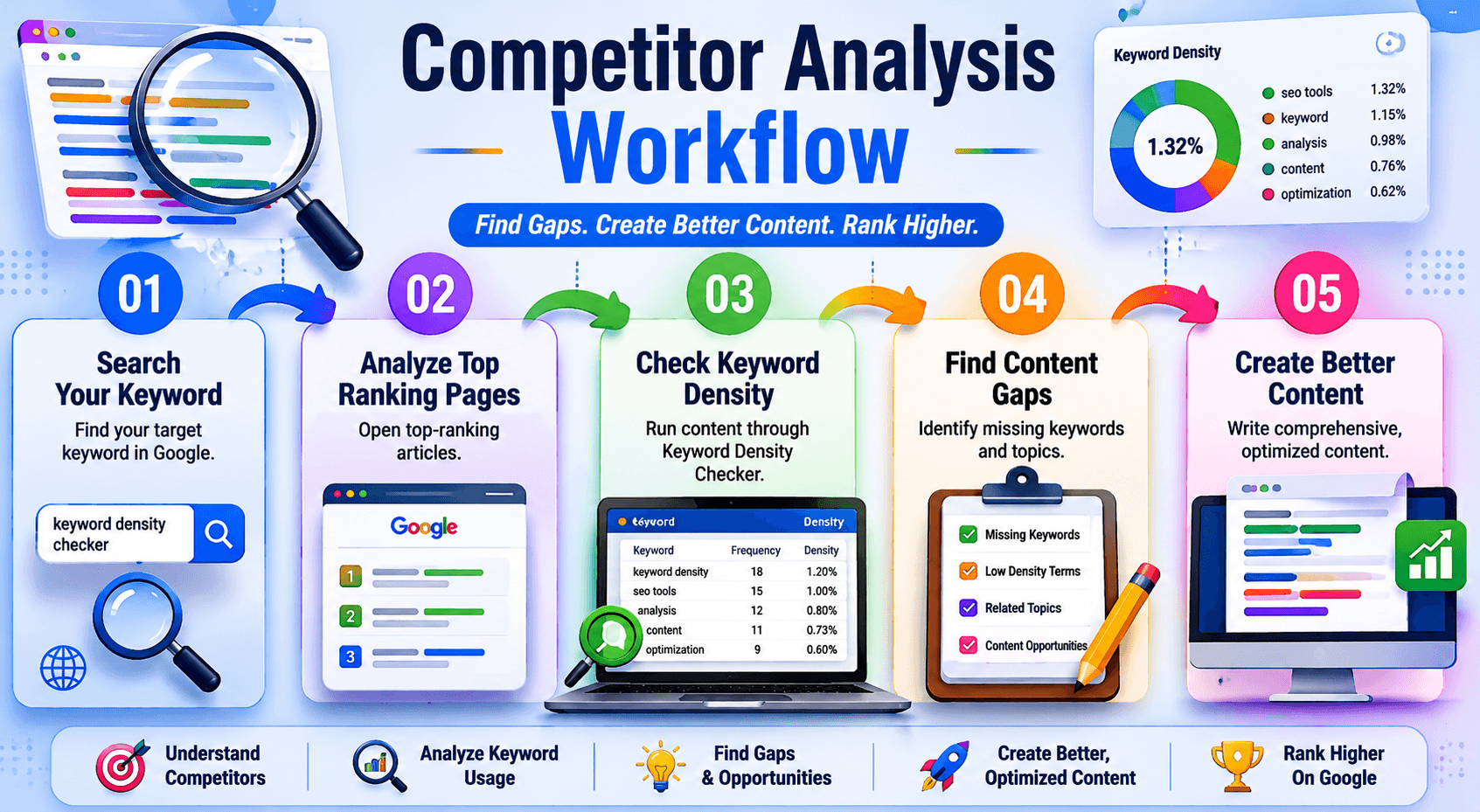
How to Analyze Competitor Content
One of the best uses of a keyword density checker is competitor analysis.
Here's a simple process:
- Search your target keyword in Google.
- Open the top-ranking pages.
- Copy their content into a keyword density checker.
- Analyze keyword usage patterns.
- Identify frequently mentioned related terms.
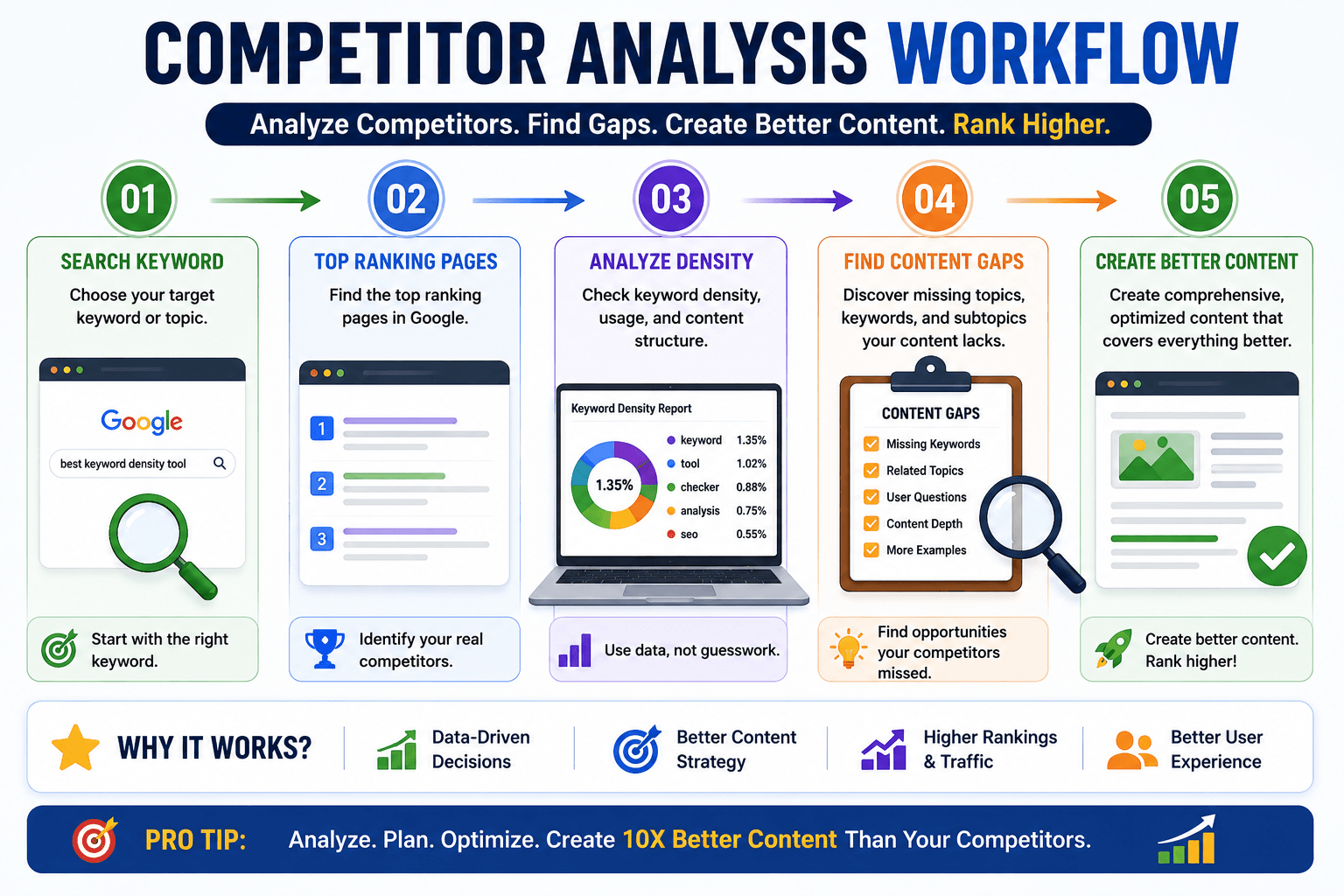
This helps you understand how top-performing content covers the topic.
Never copy competitor content. Use keyword analysis to identify content gaps and opportunities for creating something more valuable.
Keyword Density and Semantic SEO
Modern SEO is increasingly focused on semantic relevance.
Search engines analyze:
- Related phrases
- Topic coverage
- Entity relationships
- User intent
- Content depth
For example, an article about keyword density may naturally include terms such as:
- On-page SEO
- Keyword stuffing
- Search intent
- Content optimization
- SEO tools
- Content marketing
These related terms help search engines understand the page topic more accurately.
Recommended Keyword Density Guidelines
Although Google does not recommend a specific percentage, many SEO professionals follow practical guidelines.
| Density Range | Recommendation |
|---|---|
| Below 0.5% | May lack topical signals |
| 0.5% – 1.5% | Generally natural |
| 1.5% – 2.5% | Monitor for overuse |
| Above 3% | Potential keyword stuffing |
These are guidelines only—not ranking rules.
Why Bloggers Need a Keyword Density Checker
Bloggers often publish large amounts of content.
Without analysis, it's easy to accidentally:
- Overuse keywords
- Ignore important terms
- Create repetitive content
- Miss optimization opportunities
A keyword density checker helps maintain content quality while supporting SEO best practices.
How the Seovixo Keyword Density Checker Helps
The Seovixo Free Keyword Density Checker is designed for bloggers, marketers, and website owners who want fast keyword analysis without complicated software.
Key features include:
- Instant analysis
- Word count tracking
- Keyword frequency reporting
- Density percentage calculation
- Simple user interface
- Free access
Whether you're optimizing a blog post, landing page, or affiliate article, the tool provides actionable keyword insights in seconds.