Why Most Blogs Never Get Traffic (And How to Avoid Their Mistakes)
Every day, thousands of new blogs are launched. Most bloggers start with excitement, publish a few articles, and dream of getting thousands of visitors from Google. Yet after months of hard work, many blogs receive little to no traffic.

This isn't because blogging is dead. In fact, millions of people still search Google every day for answers, reviews, tutorials, and recommendations. The real reason most blogs fail is that they make critical mistakes that prevent search engines and users from finding their content.
If you've ever wondered why some blogs grow rapidly while others remain invisible, this guide will reveal the truth.
A beginner blogger published over 80 articles in one year and received fewer than 100 monthly visitors. After reviewing the site, the problem wasn't content quantity—it was poor keyword research, weak internal linking, and no content strategy. After fixing those issues and updating existing articles, traffic increased to over 8,000 monthly visitors within several months. The lesson: More content does not automatically mean more traffic.
📑 Table of Contents
- The Biggest Myth About Blogging
- Reason #1: No Keyword Research
- Reason #2: Choosing Topics That Are Too Competitive
- Reason #3: Publishing Thin Content
- Reason #4: Lack of Topical Authority
- Reason #5: Poor Content Structure
- Reason #6: Weak Internal Linking
- Reason #7: Slow Website Speed
- Reason #8: No Backlinks
- Reason #9: Ignoring User Experience
- Reason #10: Inconsistent Publishing
- Traffic Blog vs No-Traffic Blog Comparison
- The Hidden Truth About Traffic
- Reason #11: Ignoring Google's Helpful Content System
- Reason #12: Focusing on Quantity Instead of Quality
- A Realistic Traffic Growth Timeline
- What Successful Blogs Do Differently
- The Biggest Lesson Most Bloggers Learn Too Late
- Action Plan for New Bloggers
- Final Thoughts
- Frequently Asked Questions
- Key Takeaway
The Biggest Myth About Blogging
The most common belief among beginners is:
"If I publish enough articles, traffic will come automatically."
Unfortunately, Google doesn't rank content simply because it exists.
Millions of pages compete for attention every day. Search engines prioritize content that is helpful, trustworthy, relevant, and optimized for user intent.
Without a clear strategy, even hundreds of articles may never rank.
Reason #1: No Keyword Research
This is the biggest traffic killer.
Many bloggers write about topics they personally find interesting without checking whether people are actually searching for those topics.
Imagine spending five hours writing an article that receives zero searches per month.
Even if the article is excellent, Google has little opportunity to send visitors.
What Successful Bloggers Do
- Research search demand first
- Analyze keyword competition
- Understand user intent
- Target long-tail keywords
Keyword research ensures you're creating content people already want.
Reason #2: Choosing Topics That Are Too Competitive
Many new bloggers immediately target highly competitive keywords such as:
- SEO
- WordPress
- Best Hosting
- Make Money Online
These keywords are dominated by established websites with strong authority and thousands of backlinks.
A new blog has almost no chance of ranking for these terms immediately.
Instead of targeting: "Best Hosting" Target: "Best Hosting for New Bloggers Under $5/Month" Long-tail keywords often have lower competition and higher ranking potential.
Reason #3: Publishing Thin Content
Google's goal is to provide the best answers.
If your article contains only a few hundred words and barely covers the topic, it will struggle to compete against comprehensive resources.
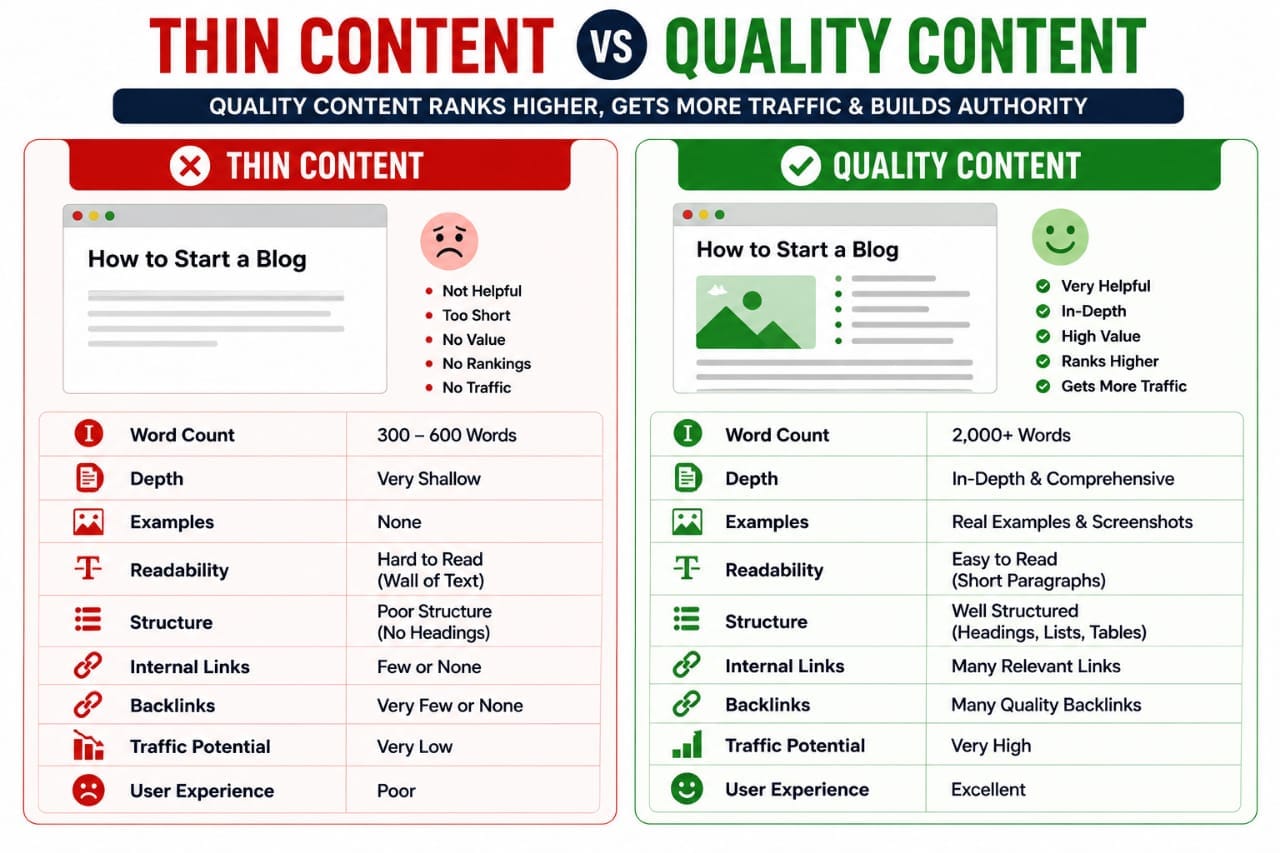
Examples of Thin Content
- Short AI-generated posts
- Generic advice
- No examples
- No research
- No screenshots
Readers want complete solutions, not surface-level information.
What High-Ranking Articles Usually Include
- Detailed explanations
- Examples
- Case studies
- Visuals
- Actionable steps
- Frequently asked questions
Reason #4: Lack of Topical Authority
Many bloggers write about random subjects.
One week they publish an SEO article.
The next week they write about fitness.
Then they publish travel content.
This confuses search engines.

Google prefers websites that demonstrate expertise within a specific topic.
Example
A blog focused entirely on SEO and WordPress is more likely to rank for SEO-related searches than a general blog covering dozens of unrelated topics.
This is called topical authority.
The more helpful content you create around one subject, the stronger your authority becomes.
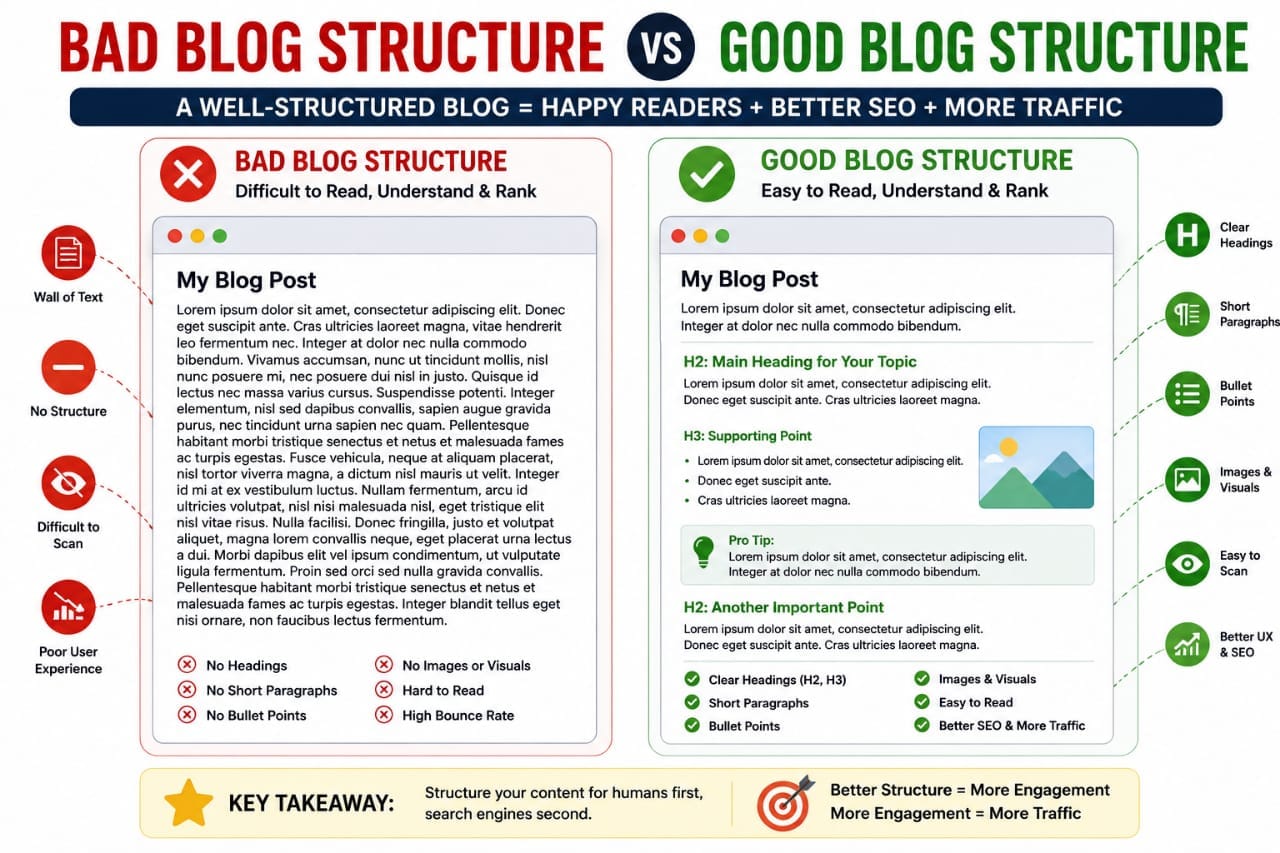
Reason #5: Poor Content Structure
Even valuable content can fail if it's difficult to read.
Most online readers scan content rather than reading every word.
If your article appears like a giant wall of text, visitors often leave immediately.
Signs of Poor Structure
- Large paragraphs
- No headings
- No bullet points
- No visuals
- No spacing
A well-structured article improves readability, user experience, and SEO.
Use:
- H2 headings
- H3 subheadings
- Bullet points
- Images
- Tables
- Highlight boxes
This keeps visitors engaged and helps search engines understand your content.
Reason #6: Weak Internal Linking
One of the biggest differences between successful blogs and struggling blogs is internal linking.
Many bloggers publish articles and never connect them together.
As a result, Google struggles to understand the relationship between pages, and users leave after reading only one article.
Why Internal Links Matter
- Help Google discover pages
- Increase page views
- Pass authority between articles
- Improve user experience
- Build topical authority
If you publish an article about "Best Hosting for Beginners," you should also link to:
- How to Start a Blog
- WordPress Setup Guide
- Hostinger Review
- Cheap Hosting vs Premium Hosting
Reason #7: Slow Website Speed
Google wants users to have a good experience.
If your website takes 6–10 seconds to load, many visitors will leave before they even see your content.
This increases bounce rate and reduces engagement signals.
Common Speed Problems
- Cheap hosting
- Large images
- Too many plugins
- Heavy themes
- No caching
How Successful Blogs Stay Fast
- Use quality hosting
- Compress images
- Enable caching
- Use Cloudflare CDN
- Optimize Core Web Vitals
Reason #8: No Backlinks
Many new bloggers believe content alone is enough.
While great content is important, backlinks remain one of Google's strongest ranking signals.
Backlinks act like votes of confidence from other websites.
Without Backlinks
- Pages index slowly
- Rankings improve slowly
- Authority grows slowly
With Quality Backlinks
- Faster rankings
- Higher authority
- More trust
- Additional referral traffic
Two blogs can publish nearly identical content. The blog with stronger backlinks often ranks higher, even if the content quality is similar.
Reason #9: Ignoring User Experience
Many websites focus only on rankings and forget about visitors.
Google increasingly measures how users interact with content.
Bad User Experience Examples
- Too many ads
- Intrusive popups
- Poor navigation
- Tiny fonts
- Cluttered layouts
If visitors quickly leave your website, Google notices.
Better User Experience
- Fast loading pages
- Readable typography
- Clean design
- Simple navigation
- Helpful content
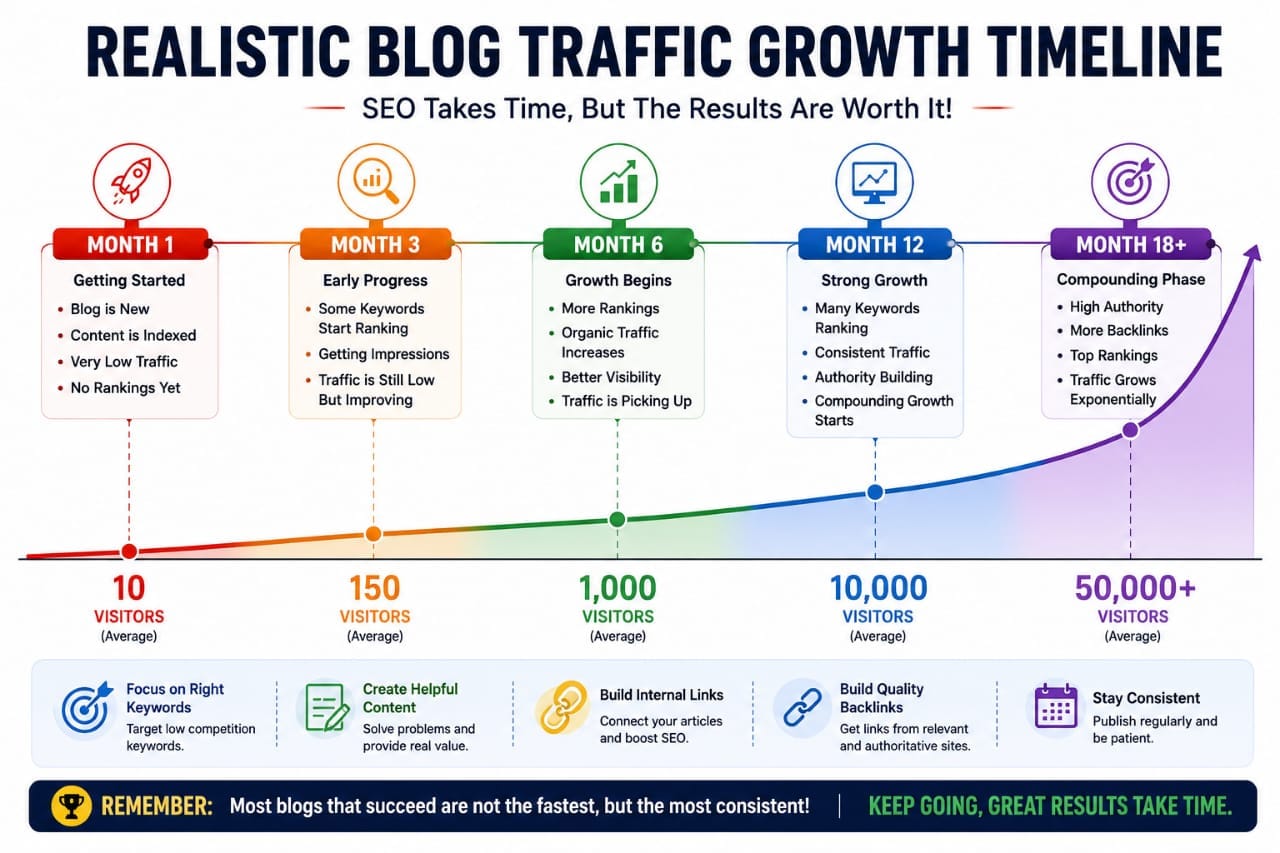
Reason #10: Inconsistent Publishing
Many bloggers quit too early.
They publish for one month, see little traffic, and stop creating content.
SEO rewards consistency.
Most successful blogs spend months building authority before seeing significant results.
What Usually Happens
- Month 1 → Very little traffic
- Month 3 → Some impressions
- Month 6 → Rankings improve
- Month 12 → Compounding growth
Patience is often the hidden factor behind blogging success.
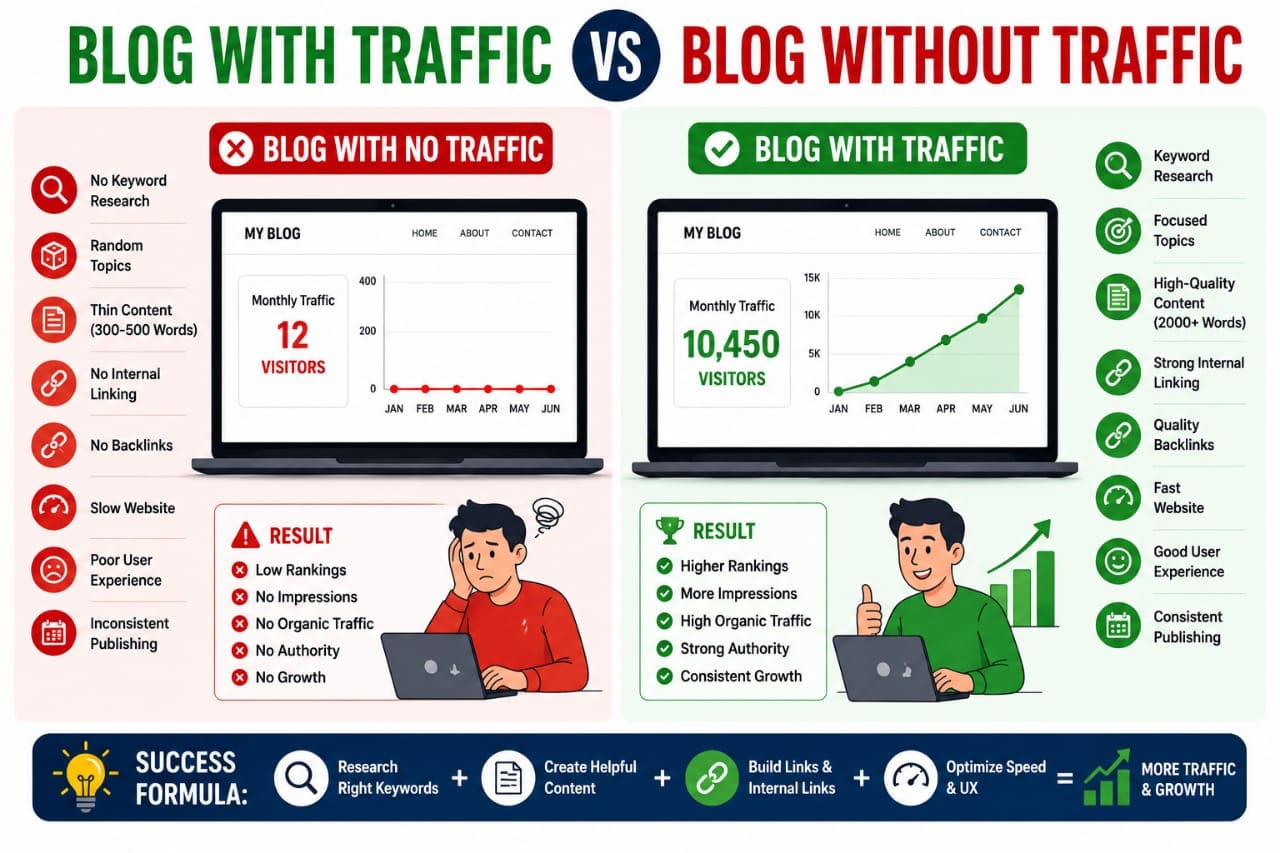
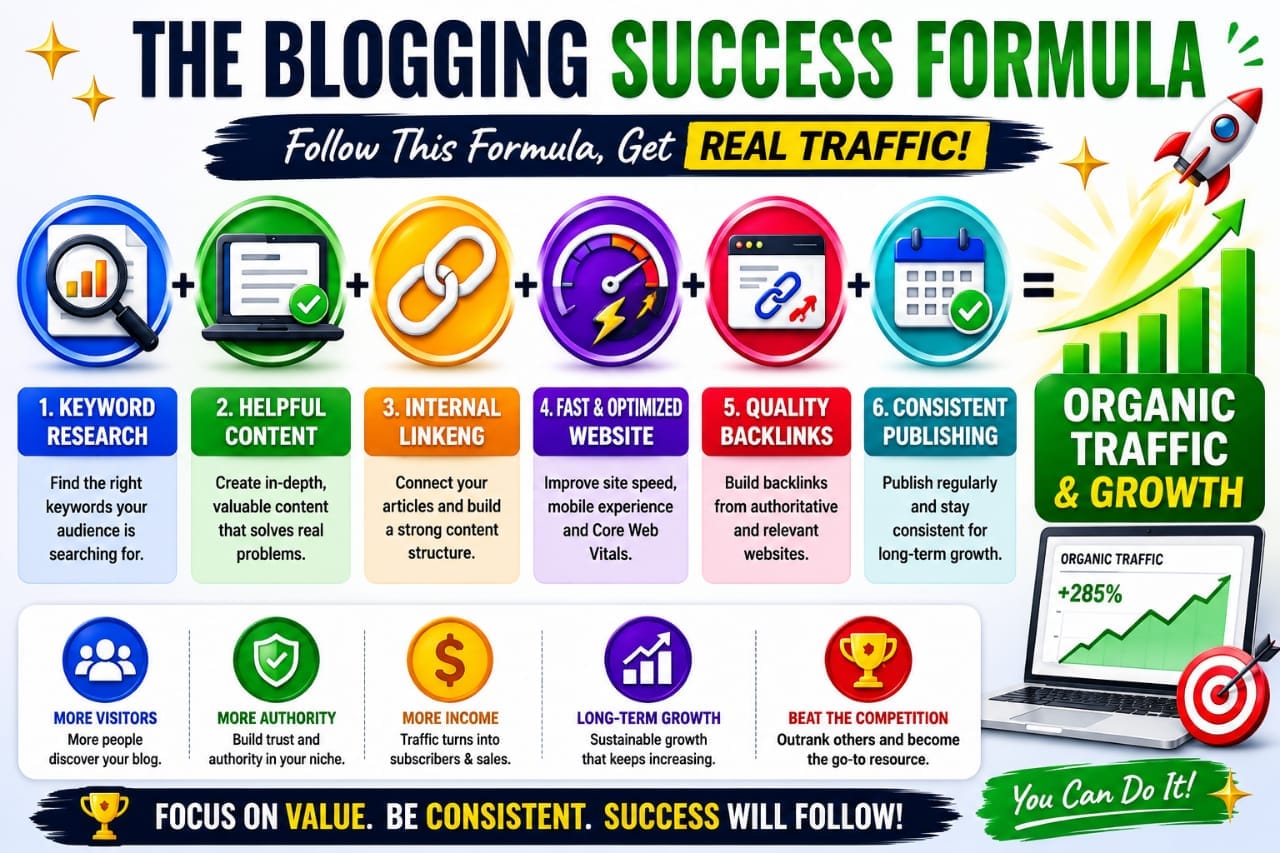
Traffic Blog vs No-Traffic Blog Comparison
| Factor | Successful Blog | Struggling Blog |
|---|---|---|
| Keyword Research | ✓ Researches keywords | ✗ Writes randomly |
| Content Quality | ✓ Comprehensive | ✗ Thin content |
| Internal Linking | ✓ Strong structure | ✗ Few links |
| Speed | ✓ Fast website | ✗ Slow pages |
| Backlinks | ✓ Builds authority | ✗ Ignores backlinks |
| Publishing | ✓ Consistent | ✗ Inconsistent |
The Hidden Truth About Traffic
Most blogs don't fail because bloggers are lazy.
They fail because they focus on the wrong activities.
Instead of researching keywords, improving content quality, building authority, and helping users, they chase shortcuts.
Successful blogs grow because they consistently solve problems better than competitors.
Traffic is a byproduct of value.
Reason #11: Ignoring Google's Helpful Content System
Google has become much better at identifying content that genuinely helps users.
The days of publishing low-quality articles stuffed with keywords are largely over.
Today, Google rewards content that demonstrates:
- Experience
- Expertise
- Authority
- Trustworthiness
This is often referred to as EEAT.
Blogs that provide original insights, practical examples, and useful solutions are more likely to rank than generic content created only for search engines.
A hosting review written by someone who actually tested the hosting provider is usually more valuable than a generic AI-generated review that simply repeats information from the company's homepage. Google increasingly prefers real experience over recycled content.
Reason #12: Focusing on Quantity Instead of Quality
Many bloggers believe they need hundreds of articles before they can get traffic.
While content volume matters, quality matters far more.
Ten exceptional articles can often outperform one hundred mediocre articles.
Quality Content Usually Includes
- Original insights
- Useful examples
- Research
- Screenshots
- Clear formatting
- Actionable advice
Instead of asking:
"How many articles should I publish?"
Ask:
"How can I make this article the best result on Google?"
A Realistic Traffic Growth Timeline
One reason bloggers quit is unrealistic expectations.
Many people expect traffic immediately after publishing.
In reality, SEO takes time.
| Time Period | Typical Results |
|---|---|
| Month 1 | Indexing begins, little traffic |
| Month 3 | More impressions appear |
| Month 6 | Some rankings improve |
| Month 12 | Traffic growth accelerates |
| Month 18+ | Authority begins compounding |
The biggest winners are often those who stay consistent while others quit.
What Successful Blogs Do Differently
When you study websites that consistently attract traffic, several patterns appear.
They Build Topic Clusters
Instead of publishing random content, they create groups of related articles.
Example SEO Cluster:
- SEO Basics
- Keyword Research
- On-Page SEO
- Technical SEO
- Link Building
- SEO Tools
This strengthens topical authority.
They Update Content
Top-performing blogs regularly refresh old content.
They:
- Update statistics
- Add new examples
- Improve internal links
- Refresh screenshots
- Expand content depth
Updating existing articles often produces faster results than constantly publishing new content.
The Biggest Lesson Most Bloggers Learn Too Late
Traffic doesn't come from publishing articles.
Traffic comes from solving problems better than competitors.
Google's mission is simple:
Show users the most helpful result.
If your content is:
- More useful
- More detailed
- More trustworthy
- Better structured
- More relevant
Then over time, rankings become much easier to achieve.
Most blogs never get traffic because they chase hacks, shortcuts, and quick wins. The blogs that succeed focus on helping readers, building authority, and publishing consistently for the long term.
Action Plan for New Bloggers
- ✔ Research keywords before writing
- ✔ Focus on low-competition opportunities
- ✔ Build topic clusters
- ✔ Improve internal linking
- ✔ Create comprehensive content
- ✔ Optimize page speed
- ✔ Build quality backlinks
- ✔ Update old content regularly
- ✔ Improve user experience
- ✔ Stay consistent for at least 12 months
Final Thoughts
Most blogs never get traffic because they lack strategy, consistency, and user-focused content.
The good news is that these problems are completely fixable.
You don't need thousands of articles or a huge budget to succeed.
You need the right topics, better content, strong SEO fundamentals, and patience.
The blogs that win are rarely the fastest. They're the ones that continue improving while others give up.
If you focus on helping readers and creating valuable content, traffic becomes a natural result of your efforts.
Frequently Asked Questions
Why do most blogs fail to get traffic?
Most blogs fail because they ignore keyword research, publish thin content, lack topical authority, and do not follow a consistent SEO strategy.
How long does it take for a new blog to get traffic?
Most blogs begin seeing meaningful organic traffic between 6 and 12 months, depending on content quality, competition, and SEO efforts.
Can a blog succeed without backlinks?
Some low-competition keywords can rank without backlinks, but quality backlinks generally help improve authority and rankings significantly.
How many blog posts should I publish?
There is no magic number. Focus on creating high-quality content that solves problems rather than publishing large amounts of low-value content.
What is the most important factor for blog traffic?
The most important factor is creating helpful content that matches search intent and provides more value than competing pages.
Should beginners focus on SEO or social media?
Both are useful, but SEO often provides more sustainable long-term traffic because content can continue attracting visitors for years.
Key Takeaway
Most blogs never get traffic because they publish content without a strategy.
Successful blogs focus on keyword research, topical authority, user experience, content quality, and consistency.
If you avoid the mistakes discussed in this guide, you'll already be ahead of the majority of bloggers online.