How Many Posts Do You Need Before Google AdSense Approval? (2026 Guide)
One of the most common questions new bloggers ask is:
"How many blog posts do I need before applying for Google AdSense?"
Unfortunately, there is no official number published by Google.

Some websites get approved with fewer than 15 articles, while others with over 100 posts still get rejected.
This often confuses beginners who assume that publishing more content automatically guarantees approval.
The reality is that Google AdSense evaluates the overall quality of your website rather than simply counting articles.
Most successful blogs apply for AdSense after publishing between 20 and 40 high-quality articles with proper pages, original content, and a good user experience.
📑 Table of Contents
- Does Google AdSense Require a Minimum Number of Posts?
- Why Google Rejects Many Blogs
- How Many Posts Are Usually Enough?
- What Matters More Than Post Count?
- Essential Pages Required Before Applying
- Real Example
- Do You Need Traffic Before AdSense Approval?
- Does Domain Age Matter?
- How Long Should Articles Be?
- How Many Categories Should Your Blog Have?
- The AdSense Approval Checklist
- What Google Actually Looks For
- Common Reasons for AdSense Rejection
- Can You Get Approved With 20 Posts?
- The Best Strategy for New Bloggers
- Real AdSense Approval Examples
- Does AI Content Affect AdSense Approval?
- How Long Does AdSense Approval Take?
- Should You Wait for Traffic Before Applying?
- The Content Formula That Works Best
- AdSense Approval Blueprint for New Bloggers
- The Biggest AdSense Myth
- Final Thoughts
- Frequently Asked Questions
- Key Takeaway
Does Google AdSense Require a Minimum Number of Posts?
No.
Google does not specify a minimum number of articles for approval.
According to the official Google AdSense Program Policies , approval depends on content quality, policy compliance, and website value rather than article count.
This means:
- 10 excellent articles can outperform 100 weak articles.
- Quality matters more than quantity.
- User experience matters more than word count.
- Original content matters more than AI-generated filler.
Why Google Rejects Many Blogs
Many bloggers focus only on publishing articles while ignoring the factors Google actually reviews.
Common rejection reasons include:
- Thin content
- Poor navigation
- Duplicate content
- Incomplete pages
- Lack of trust signals
- Low-value content
Even a website with 50 articles can be rejected if these problems exist.
Many bloggers rush to apply after publishing 5–10 articles. In most cases, the site simply isn't mature enough to demonstrate long-term value.
How Many Posts Are Usually Enough?
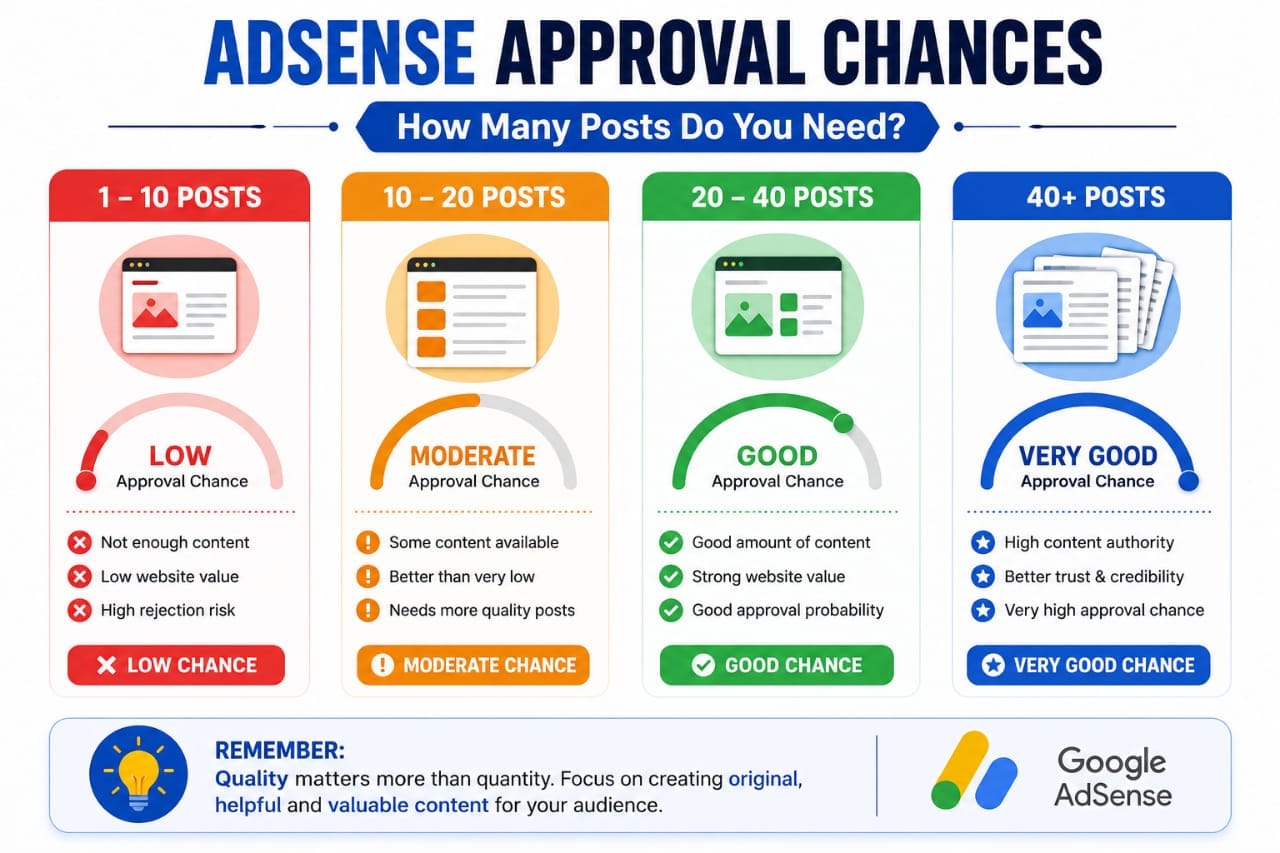
Based on real-world AdSense approvals across blogging communities, the following ranges are common:
| Number of Posts | Approval Chances |
|---|---|
| 1–10 Posts | Low |
| 10–20 Posts | Moderate |
| 20–40 Posts | Good |
| 40+ Posts | Very Good (if quality is maintained) |
The sweet spot for many new websites is around 20–40 useful articles.
What Matters More Than Post Count?
Google wants websites that genuinely help users.
When reviewers assess your site, they look beyond article numbers.
1. Original Content
Your articles should be unique and written to help readers.
Avoid copying content from other websites.
2. Topical Relevance
Websites focused on a specific niche often perform better than sites covering random topics.
For example:
- SEO
- Blogging
- WordPress
- Digital Marketing
A focused site demonstrates expertise.
3. Content Depth
Short, shallow articles often struggle.
Aim for comprehensive content that answers user questions thoroughly.
Essential Pages Required Before Applying
Many AdSense rejections occur because websites lack basic trust pages.
Before applying, make sure your site includes:
- About Us
- Contact Page
- Privacy Policy
- Terms & Conditions
- Disclaimer
These pages help establish credibility and professionalism.
You can review Google's requirements through the official Google Publisher Policies documentation.
Real Example
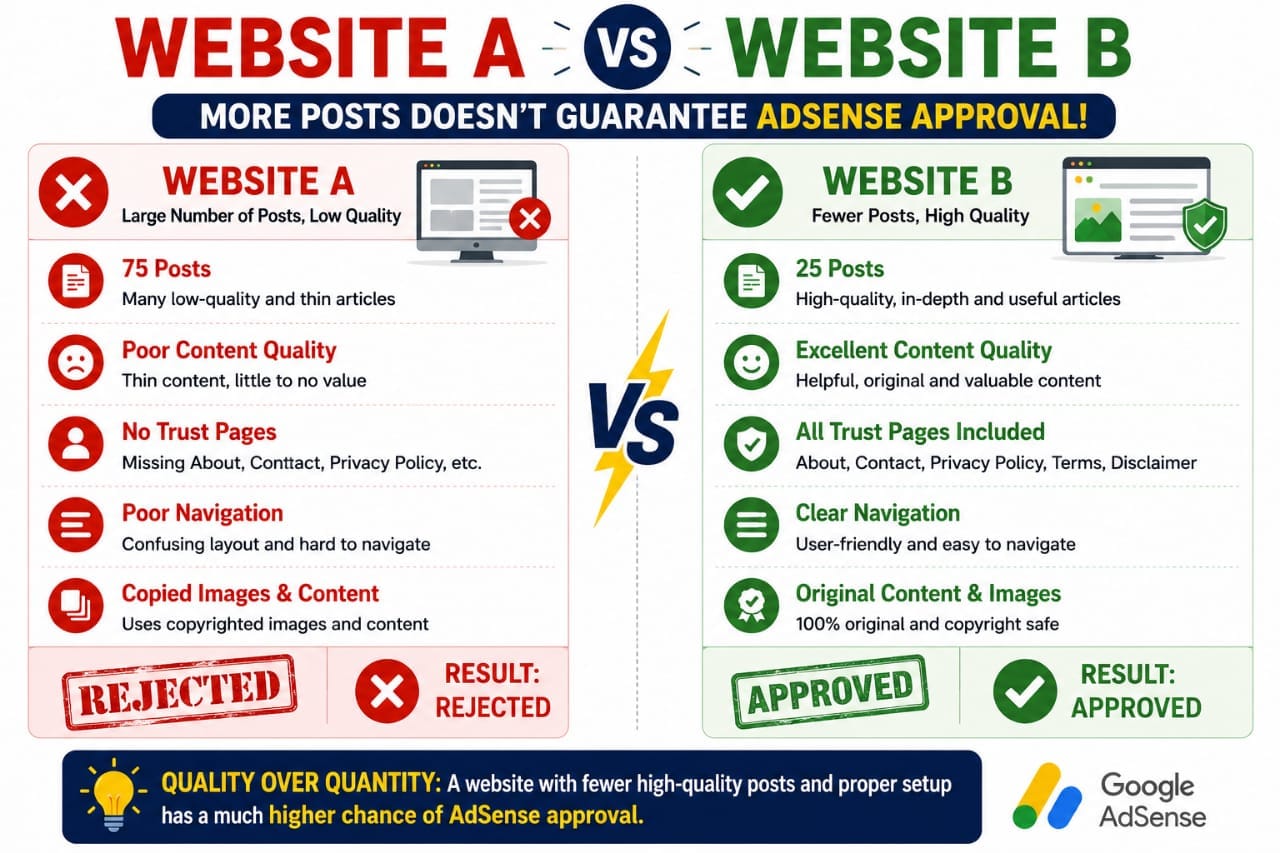
Consider two websites:
Website A
- 75 articles
- Thin content
- No About page
- Poor navigation
Website B
- 25 detailed articles
- Fast loading pages
- Trust pages included
- Clear niche focus
Website B often has a much better chance of approval despite having fewer articles.
Do You Need Traffic Before AdSense Approval?
This is another popular myth among beginner bloggers.
The truth is that Google AdSense does not require a specific amount of traffic before approval.
Many websites have been approved with fewer than 50 daily visitors.
What matters most is the quality of your website.
Google wants to see:
- Useful content
- Original articles
- Proper navigation
- Policy compliance
- Positive user experience
You don't need thousands of visitors before applying. Many bloggers receive approval while their websites are still relatively new and growing.
Does Domain Age Matter?
Years ago, some countries required websites to be at least six months old before AdSense approval.
Today, Google focuses much more on content quality than domain age.
A website that is:
- Well-designed
- Content-rich
- User-friendly
- Policy-compliant
can often be approved regardless of age.
Many successful bloggers receive approval within their first few months.
How Long Should Articles Be?
There is no official minimum word count requirement.
However, detailed content generally performs better.
| Article Length | Recommendation |
|---|---|
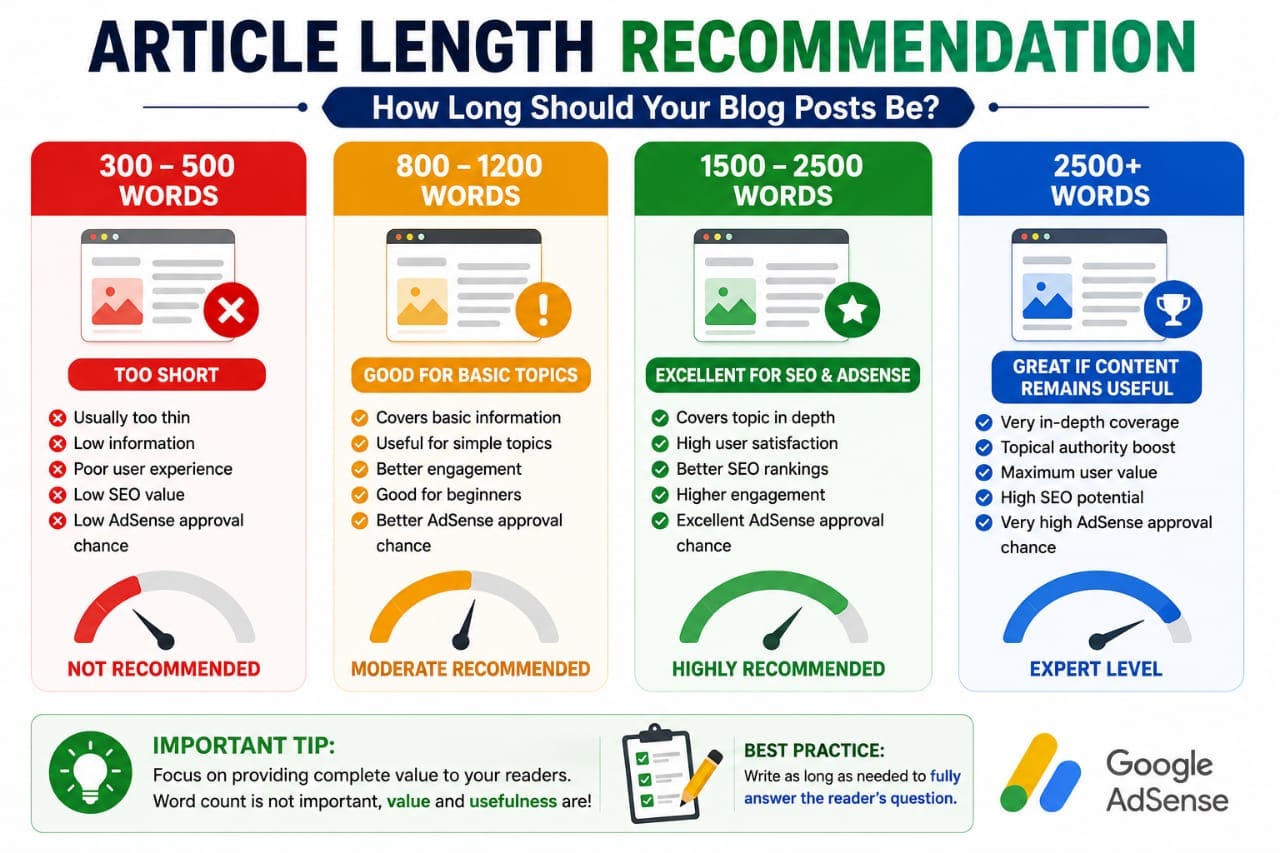
| 300–500 Words | Usually too thin |
| 800–1200 Words | Good for basic topics |
| 1500–2500 Words | Excellent for SEO and AdSense |
| 2500+ Words | Great when content remains useful |
Focus on fully answering user questions rather than hitting a specific word count.
How Many Categories Should Your Blog Have?
Many new bloggers create dozens of categories before they even have content.
This creates a poor site structure.
A better approach is to focus on a few core topics.
Example:
- SEO
- Blogging
- WordPress
- Web Hosting
This helps both users and search engines understand your website.
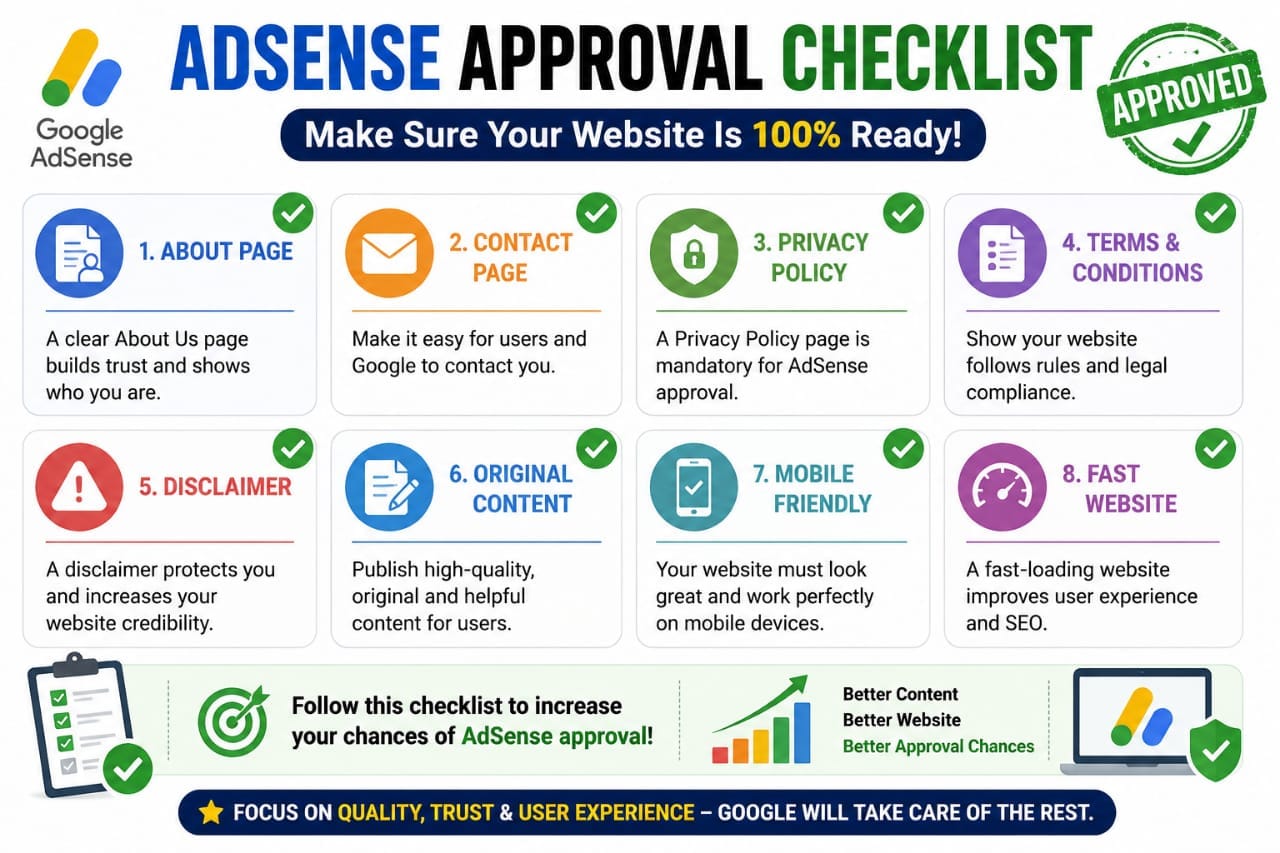
The AdSense Approval Checklist
Before applying, make sure your website meets these requirements.
✓ Content Checklist
- 20–40 quality articles
- Original content
- No copied material
- Helpful information
- Proper grammar
- Clear headings
✓ Website Checklist
- Mobile-friendly design
- Fast loading speed
- Easy navigation
- Clean layout
- SSL certificate installed
✓ Trust Checklist
- About Us page
- Contact page
- Privacy Policy
- Terms and Conditions
- Disclaimer
What Google Actually Looks For
Google reviewers evaluate whether your website provides value to users.
According to the highlighted Google Search Central Guidelines , high-quality websites focus on helpful content and user experience.
Ask yourself:
- Would I trust this website?
- Would I bookmark this content?
- Does this article solve a problem?
- Is the information original?
If the answer is yes, you're moving in the right direction.
Common Reasons for AdSense Rejection
Understanding why websites fail can help you avoid costly mistakes.
1. Thin Content
Very short articles often fail to demonstrate value.
2. AI Content Without Editing
AI-generated content that lacks expertise or usefulness may create quality issues.
3. Incomplete Website
Missing trust pages can hurt approval chances.
4. Poor Navigation
If visitors cannot easily find information, the user experience suffers.
5. Copyright Issues
Using copied text or images can result in rejection.
Publishing dozens of low-quality articles quickly is often less effective than publishing a smaller number of excellent articles.
Can You Get Approved With 20 Posts?
Yes.
Many bloggers have received AdSense approval with around 20 high-quality articles.
However, approval depends on the entire website—not just article count.
A site with 20 excellent articles often performs better than a site with 100 weak articles.
The Best Strategy for New Bloggers
If you're preparing for AdSense approval in 2026, focus on:
- Publishing 20–40 detailed articles
- Building topical authority
- Creating trust pages
- Improving site speed
- Optimizing mobile usability
- Helping readers solve problems
This approach aligns closely with Google's quality expectations.
Real AdSense Approval Examples
One of the biggest reasons bloggers get confused about AdSense approval is that every website is different.
Let's look at some realistic scenarios.
Example 1: Fast Approval
- 25 high-quality articles
- Clear niche focus
- Fast website
- Trust pages included
- Mobile-friendly design
Result: Approved.
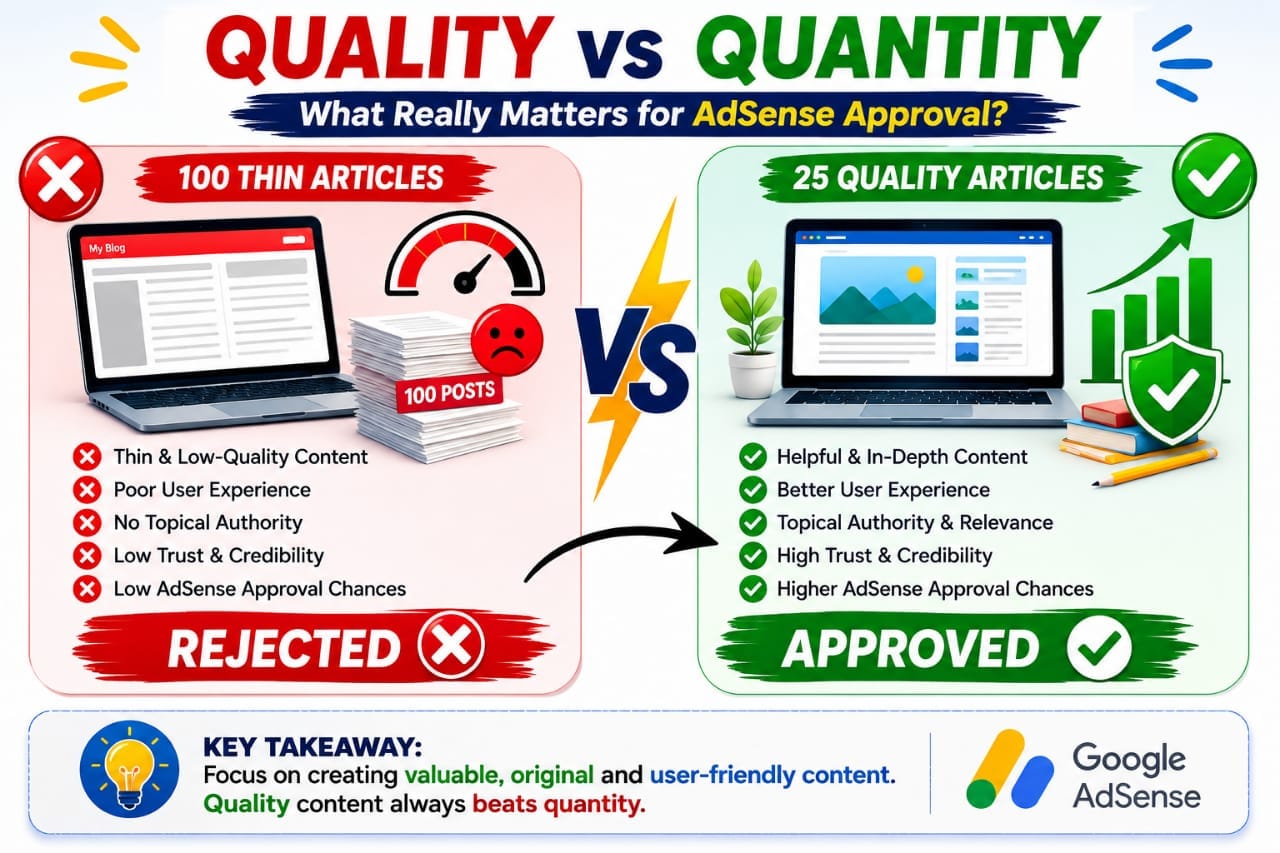
Example 2: Rejected Website
- 80 short articles
- Thin content
- No About page
- Poor navigation
- Copied images
Result: Rejected.
This demonstrates why quality matters more than quantity.
Google evaluates the overall value of your website. More articles alone do not guarantee approval.
Does AI Content Affect AdSense Approval?
This is one of the most frequently asked questions in 2026.
Google does not automatically reject content because AI was used.
However, Google does evaluate content quality.
According to the highlighted Google Helpful Content Guidelines , content should be created primarily to help users.
If AI-generated content is:
- Accurate
- Helpful
- Well-edited
- Original
- User-focused
It can perform well.
If it is spammy, repetitive, or low-value, approval becomes much more difficult.
How Long Does AdSense Approval Take?
Approval times vary.
Some websites receive approval within a few days.
Others may wait several weeks.
| Situation | Typical Time |
|---|---|
| Fast Review | 2–7 Days |
| Normal Review | 1–3 Weeks |
| Additional Review | Several Weeks |
Patience is important during the review process.
Should You Wait for Traffic Before Applying?
Not necessarily.
If your website already has:
- 20–40 quality articles
- Trust pages
- Good navigation
- Original content
- Policy compliance
You can apply even if traffic is still growing.
Many approved websites receive fewer than 100 visitors per day when they submit their application.
The Content Formula That Works Best
Instead of focusing only on article count, focus on content quality.
A strong content portfolio might look like:
- 10 pillar articles (2000+ words)
- 10 supporting articles (1000–1500 words)
- 5–10 tool pages
- Helpful resource pages
This structure demonstrates expertise and topical authority.
AdSense Approval Blueprint for New Bloggers
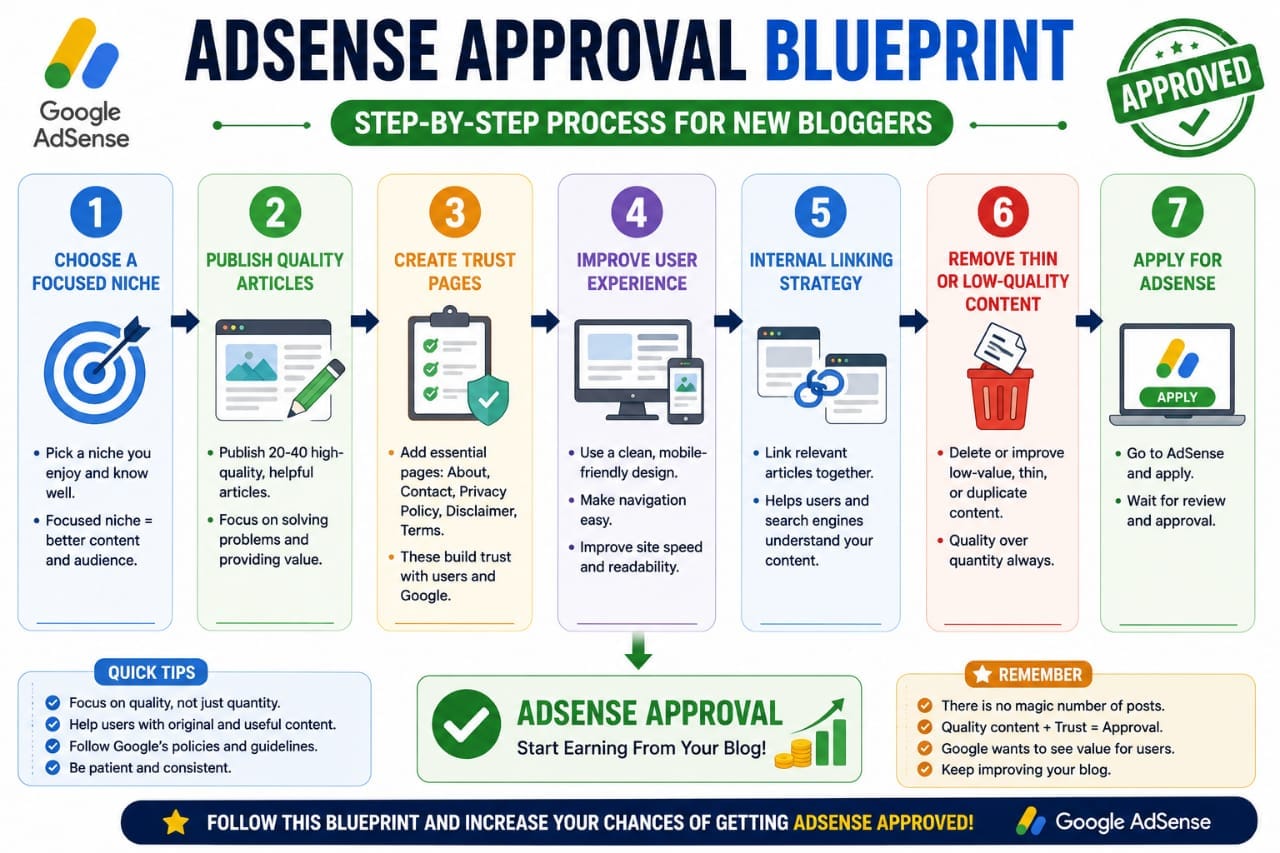
Step 1
Choose a focused niche.
Step 2
Publish 20–40 useful articles.
Step 3
Create About, Contact, Privacy Policy, Disclaimer, and Terms pages.
Step 4
Improve website speed and mobile usability.
Step 5
Add internal links between articles.
Step 6
Remove thin or low-quality content.
Step 7
Apply for AdSense.
The Biggest AdSense Myth
The biggest myth is:
"I need 100 posts before applying."
This is simply not true.
Google has never published a requirement stating that websites must have 50, 100, or 200 posts.
The focus should always be:
- Quality
- Trust
- User experience
- Original content
These factors have a much greater impact on approval than article count.
Final Thoughts
So, how many posts do you need before AdSense approval?
For most websites, a range of 20–40 high-quality articles is a practical target.
However, article count alone is not enough.
Google wants websites that provide genuine value to users.
If your site offers original content, a great user experience, and strong trust signals, approval becomes much more likely.
Instead of chasing a magic number, focus on building a website that users would genuinely find helpful and trustworthy.
📚 Helpful Resources & Related Guides
🌐 Official Resources
🔗 Related Articles on Seovixo
Frequently Asked Questions
Can I get AdSense approval with 20 posts?
Yes. Many websites receive approval with around 20 quality articles if the site meets Google's content and policy requirements.
Can I get AdSense approval with no traffic?
Yes. There is no official traffic requirement for AdSense approval.
Do all articles need to be 2000 words?
No. Articles should be long enough to fully answer the user's question and provide value.
How many pages should my website have?
In addition to blog posts, include About, Contact, Privacy Policy, Terms, and Disclaimer pages.
Does domain age matter for AdSense?
Not as much as content quality and policy compliance.
What is the most important factor for approval?
Original, helpful content combined with a trustworthy website structure.
Key Takeaway
There is no official minimum number of posts required for AdSense approval.
Most successful bloggers apply after publishing 20–40 high-quality articles, but the real deciding factors are content quality, user experience, trust signals, and policy compliance.
Build a website that helps users first, and AdSense approval becomes much easier to achieve.